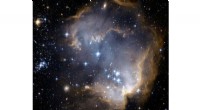
The presence of dust and gas in ERQs has a profound impact on the star formation process. Dust absorbs ultraviolet radiation from young stars, preventing them from ionizing the surrounding gas and forming new stars. Additionally, the gas in ERQs is often very dense, which further inhibits star formation. As a result, ERQs are often found in regions of their host galaxies where star formation has been quenched or completely extinguished.
The quenching of star formation in ERQs is thought to be a key factor in the evolution of galaxies. By preventing the formation of new stars, ERQs can help to transform galaxies from star-forming systems into more passive systems, such as elliptical galaxies. Additionally, the feedback from ERQs can heat the surrounding gas and prevent it from cooling and collapsing into new stars. This can lead to the formation of galactic winds, which can further strip gas from the galaxy and inhibit star formation.