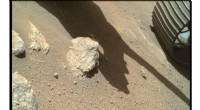
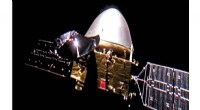
Perseverance landed in Jezero crater on February 18, 2021. Since then, it has been driving across the crater floor, imaging its surroundings, and collecting data from the Martian atmosphere. On March 3, 2021, the rover used its "abrasion tool" to grind away the surface of a rock and collect a sample of powdered rock. This sample will be stored on the rover until it can be returned to Earth.
The Perseverance rover is an important part of NASA's plans to explore Mars and search for signs of life on the planet. If the rover is successful in finding evidence of ancient microbial life on Mars, it will be a major scientific breakthrough.
Key Instruments on the Perseverance Rover:
* Mastcam-Z: A pair of high-resolution cameras that will provide images of the Martian surface.
* SuperCam: A laser-induced breakdown spectroscopy (LIBS) instrument that will analyze the composition of rocks and soils.
* PIXL: A planetary X-ray diffractometer that will provide information about the mineralogy of rocks and soils.
* Sherloc: A Raman spectrometer and fluorescence imager that will investigate organic compounds in rocks and soils.
* MOXIE: A Mars oxygen ISRU experiment that will produce oxygen from the Martian atmosphere.
* MEDA: A Mars environmental dynamics analyzer that will measure meteorological conditions on Mars.
* RIMFAX: A ground-penetrating radar that will image the subsurface structure of Mars.
Search for Signs of Life:
The Perseverance rover will search for signs of past microbial life on Mars. This will include looking for evidence of organic molecules, which are the building blocks of life. The rover will also search for evidence of water-rock interactions, which can create conditions that are favorable for life.
If the Perseverance rover finds evidence of past microbial life on Mars, it will be a major scientific breakthrough. It will help us to understand the history of life in the solar system and may even provide clues about the origin of life itself.