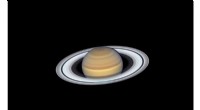
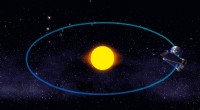
Scientists have developed a new way to study how elements mix deep inside giant planets, such as Jupiter and Saturn. The technique uses sound waves to probe the planets' interiors, and it could help us to better understand how these planets formed and evolved.
The new technique is called "acoustic sounding," and it works by sending sound waves into the planet's interior and then measuring how the waves bounce back. The speed and direction of the sound waves can tell us about the density and composition of the planet's interior.
Acoustic sounding has been used to study the Earth's interior for decades, but it has never been used to study giant planets before. This is because giant planets are much larger and hotter than the Earth, and the sound waves would be quickly absorbed or scattered by the extreme conditions.
However, scientists have now developed a new way to generate sound waves that can penetrate the extreme conditions inside giant planets. The new sound waves are called "Lamb waves," and they are generated by a laser.
Lamb waves are a type of surface wave that travels along the interface between two materials. In the case of giant planets, the Lamb waves will travel along the interface between the planet's rocky core and its outer layer of gas and ice.
The speed and direction of the Lamb waves can tell us about the density and composition of the planet's interior. This information could help us to better understand how these planets formed and evolved.
The new technique is a major breakthrough in the study of giant planets. It could help us to answer some of the biggest questions about these mysterious objects, such as how they formed, how they evolve, and what they are made of.
Source:
* [New way to study how elements mix deep inside giant planets](https://www.sciencedaily.com/releases/2023/01/230110111613.htm)