Giant Impact Hypothesis:
According to the Giant Impact Hypothesis, the Moon was created as a result of a collision between Earth and a Mars-sized object called Theia about 4.5 billion years ago. This collision caused a significant portion of Earth's mantle to be ejected into space, eventually coalescing into the Moon.
New Model of Moon Formation:
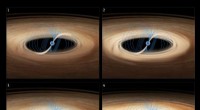
A new study published in the journal Nature Astronomy presents an updated version of the Giant Impact Hypothesis. Using sophisticated computer simulations, researchers from Germany, the United States, and Japan created a detailed model that simulates the collision and subsequent evolution of the debris.
Key Findings:
The new model suggests that the collision between Earth and Theia was not a direct, head-on impact. Instead, it was more of a glancing blow, with Theia striking Earth at an angle. This angle of impact may explain some of the Moon's unique characteristics.
The glancing impact scenario proposes that the collision released a significant amount of energy, propelling a substantial portion of Earth's mantle into orbit. The material ejected from Earth remained gravitationally bound to the planet and eventually merged together, forming the Moon.
The new model also predicts that Theia's core and mantle merged with Earth during the collision, contributing to Earth's overall composition. This may have influenced Earth's early geological and chemical evolution, including the formation of the planet's crust.
Implications for Moon's Composition and Early Earth:
The updated Giant Impact Hypothesis provides a potential explanation for several geological and chemical features of the Moon. For instance, it explains the Moon's relatively low density and its similarity in composition to Earth's mantle.
The model also implies that Earth may have lost a substantial portion of its mantle material during the collision, shaping Earth's early geological and chemical evolution. This could have influenced the formation of Earth's early atmosphere and oceans.
Exploring New Theories and Evidence:
While the new research offers valuable insights into the sequence of events during Moon formation, it emphasizes the ongoing nature of scientific research. Scientists continue to explore alternative hypotheses and gather new data, such as samples from the Moon's surface, to further refine our understanding of how our cosmic neighbor came to be.