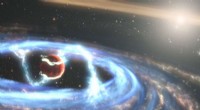
The exoplanet in question is called TOI 700 d, and it is located about 100 light-years from Earth in the constellation Dorado. It is about the same size as Earth and orbits a red dwarf star. Red dwarfs are smaller and cooler than our Sun, and they emit less light. This makes it difficult to detect planets orbiting red dwarfs, as the planets' light is often too faint to be seen.
However, the JWST is able to detect infrared light, which is emitted by warm objects. This allowed astronomers to detect TOI 700 d's atmosphere and analyze its composition. The telescope detected the presence of water vapor, carbon dioxide, and methane in the atmosphere. These gases are essential for life as we know it, and their presence suggests that TOI 700 d could be habitable.
Of course, the presence of water alone does not guarantee that a planet is habitable. There are many other factors that need to be considered, such as the planet's temperature, pressure, and the composition of its atmosphere. However, the detection of water on TOI 700 d is a very promising sign, and it suggests that we may be one step closer to finding life beyond Earth.
Here is a more detailed explanation of how astronomers detected water on TOI 700 d:
1. The JWST observed TOI 700 d as it passed in front of its host star.
2. As TOI 700 d passed in front of the star, some of the star's light passed through the planet's atmosphere.
3. The JWST was able to detect the absorption of certain wavelengths of light by the gases in the atmosphere.
4. The presence of water vapor was detected by the absorption of infrared light at a wavelength of 2.4 microns.
5. The amount of water vapor in the atmosphere was estimated by measuring the depth of the absorption.
6. The temperature and pressure of the atmosphere were also estimated based on the absorption of other gases.
7. The data collected by the JWST was used to create a model of the planet's atmosphere.
8. The model suggests that TOI 700 d could have a habitable surface temperature and a liquid water ocean.
This discovery is a major breakthrough in our search for life beyond Earth. It shows that the JWST is capable of detecting water on potentially habitable exoplanets, and it opens up the possibility of finding many more Earth-like planets in the future.