Magnetars, the most highly magnetized neutron stars known to exist, are believed to form from rapidly rotating stellar cores. When a massive star exhausts its nuclear fuel, it explodes as a supernova. If the star has a sufficiently fast rotation, the core left behind may survive the cataclysmic event. Such a stellar remnant is expected to be born with strong magnetic fields, owing to the conservation of the star's angular momentum during the collapse.
"Studying magnetars allows us to gain insights into the supernova mechanism and the fundamental physics related to these compact objects and the extreme environments around them," says study lead author Dr. Yuichiro Sekiguchi from RIKEN Interdisciplinary Theoretical and Mathematical Sciences (iTHEMS). "But the formation scenario of these intriguing astrophysical objects remains unclear, partly due to a lack of direct observational evidence."
Neutron stars are notoriously difficult to observe. They emit radiation across a broad spectrum of wavelengths, making them challenging targets for telescopes designed for specific wavelengths. Among the different wavelength bands, radio waves offer a promising tool for unveiling magnetar properties, particularly through their radio pulsations -- periodic emission of radio waves that appears as rapid flashing.
The present study focused on a specific type of radio pulsation known as 'free precession,' which is observed as small periodic shifts in the arrival times of radio waves from pulsars. "If this phenomenon is detected, it can directly probe the rotation rate and internal structure of the neutron star," explains Sekiguchi.
The researchers simulated radio waves from free precession of magnetars born in different supernova models, considering the effects of both the rotation rate and the magnetic field strength.
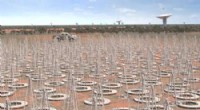
They show that the free precession signature becomes more apparent at lower radio frequencies, such as those observed with the Low-Frequency Array (LOFAR) radio telescope in the Netherlands. Moreover, the expected radio signal depends on the rotation rate of the neutron star: slower-rotating neutron stars tend to exhibit a clearer signal compared to rapidly rotating ones.
The researchers hope their findings will contribute to ongoing observational efforts using LOFAR and prepare the ground for future radio observations. In particular, the ongoing LOFAR Supernova Key Project aims to unveil properties of magnetars born from rapidly rotating massive progenitors.
"Combining multi-wavelength observations and theoretical models will bring us closer to unraveling the mysteries of these enigmatic remnants," concludes Sekiguchi.