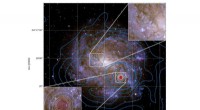
Near black holes, the intense gravitational field causes light and matter to bend and curve. This effect, known as gravitational lensing, is a fundamental prediction of Einstein's theory of general relativity. It leads to several intriguing and observable phenomena:
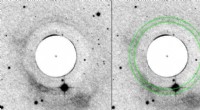
1. Einstein Rings: When a distant light source, such as a star or a galaxy, is directly behind a black hole, its light bends and forms a perfect circular ring around the black hole. This ring-like structure is called an Einstein ring. The size of the ring depends on the mass of the black hole and the distance to the light source.
2. Multiple Images: Gravitational lensing can also create multiple images of the same object. When light passes near a black hole, it can travel along different paths and arrive at the observer from different directions. This phenomenon leads to the appearance of multiple images of the same object, often forming an arc or a series of arcs around the black hole.
3. Time Delay: Gravitational lensing can also cause a time delay in the arrival of light signals. When light passes near a black hole, it experiences a gravitational delay due to the curvature of spacetime. This time delay can be measured and used to infer the mass and other properties of the black hole.
Accretion Disk
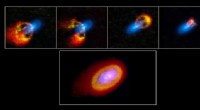
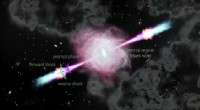
In addition to gravitational lensing, the region near black holes is often surrounded by an accretion disk. An accretion disk is a swirling disk of gas and dust that orbits the black hole. As the material in the accretion disk falls toward the black hole, it heats up and emits intense radiation, making it a bright source of light.
Spaghettification
As objects approach the event horizon of a black hole, they experience extreme tidal forces. This intense gravitational gradient causes objects to stretch and become extremely thin and elongated. This phenomenon is colloquially known as "spaghettification." The tidal forces near a black hole are so powerful that they can tear apart even massive objects like stars and planets.
The study of the region near black holes provides valuable insights into the extreme conditions of the universe and tests our understanding of fundamental physics. Observations of gravitational lensing effects and other phenomena near black holes play a crucial role in unraveling the mysteries of these enigmatic objects and advancing our knowledge of the universe.