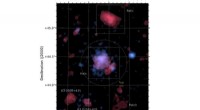
The team, including scientists from other institutions, used observations from cutting-edge telescopes, including the Atacama Large Millimeter/submillimeter Array (ALMA) in the Atacama Desert of Chile, to study a distant galaxy known as CR7. CR7, which existed approximately 700 million years after the Big Bang, emits a rare type of light known as Lyman-alpha emission.
By analyzing the wavelength of the Lyman-alpha emission from CR7, researchers discovered the presence of a previously undetected reservoir of neutral hydrogen gas surrounding the galaxy. Neutral hydrogen gas is a crucial fuel needed to power the formation of stars in the early universe. The observed hydrogen gas likely fueled star formation in CR7 and contributed to the reionization of the universe, which cleared the fog of neutral hydrogen that permeated the early cosmos and made it transparent to ultraviolet light.
The team also found that the ionized gas surrounding CR7 was clumpy rather than smoothly distributed, likely the result of energetic processes such as supernova explosions and outflows of matter from the galaxy. This clumpiness suggests a dynamic and chaotic environment in the galaxy during its intense star formation phase.
Lead author Sebastiano Cantalupo, a postdoctoral researcher at UT Austin's Department of Astronomy, explained that the findings provide new clues about the evolution of the very first generations of galaxies and the sources of energy responsible for reionization.
The study, recently published in the journal Science, contributes to our understanding of how early galaxies shaped the universe and set the stage for the structures we observe in the present-day cosmos. It highlights the potential of forthcoming space telescopes, like the James Webb Space Telescope, to further study these distant galaxies and shed more light on the early history of the universe.