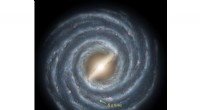
- Rotation Curve: By measuring the speed at which stars and gas rotate around the center of the Milky Way, astronomers can use the principles of circular motion to estimate the mass within a given radius.
- Gravitational Lensing: The gravitational force of the Milky Way can distort the light from distant galaxies, causing a phenomenon known as gravitational lensing. By studying these distortions, astronomers can infer the mass of the intervening matter, including the Milky Way.
- Dynamical Modeling: Astronomers construct detailed models of the Milky Way's structure and dynamics, including the distribution and motion of stars and gas. By simulating the galaxy's behavior over time, they can estimate its total mass.
Combining these methods and incorporating various assumptions, astronomers estimate the mass of the Milky Way to be in the range of 1 to 2 trillion solar masses. One solar mass is equivalent to the mass of our Sun. This means that the Milky Way contains several hundred billion stars, as well as vast amounts of gas and dark matter.
The mass of the Milky Way is dominated by dark matter, a mysterious form of matter that does not emit or reflect any electromagnetic radiation. Dark matter is thought to comprise approximately 85% to 90% of the galaxy's total mass, with the remaining 10% to 15% consisting of visible matter such as stars, gas, and dust.
The precise mass of the Milky Way is still an active area of research, and astronomers continue to refine their estimates as more data becomes available and their understanding of the galaxy deepens.