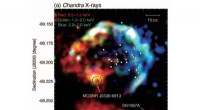
The Champagne supernova is located in the constellation Dorado, about 170 million light-years away. It was discovered in 2014 by astronomers using the Hubble Space Telescope. Initially thought to be a typical supernova, the object's brightness continued to increase instead of fading.
Observations of the Champagne supernova revealed that it is powered by a compact object at its center, which is likely a neutron star or black hole. The object is rapidly spinning and ejecting material into space, creating a bright jet of particles. This jet is what causes the supernova's unusual brightness.
The Champagne supernova is a rare type of supernova called a "Type Iax supernova." These supernovae are thought to occur when a white dwarf star explodes after merging with a companion star. The merger of the two stars creates a rapidly spinning object that powers the supernova's jet.
The Champagne supernova is challenging scientists' understanding of how Type Iax supernovae work. Astronomers are still studying the object to learn more about its properties and how it differs from other supernovae. By studying the Champagne supernova, astronomers hope to gain insights into the different ways that stars can explode and contribute to the evolution of the universe.