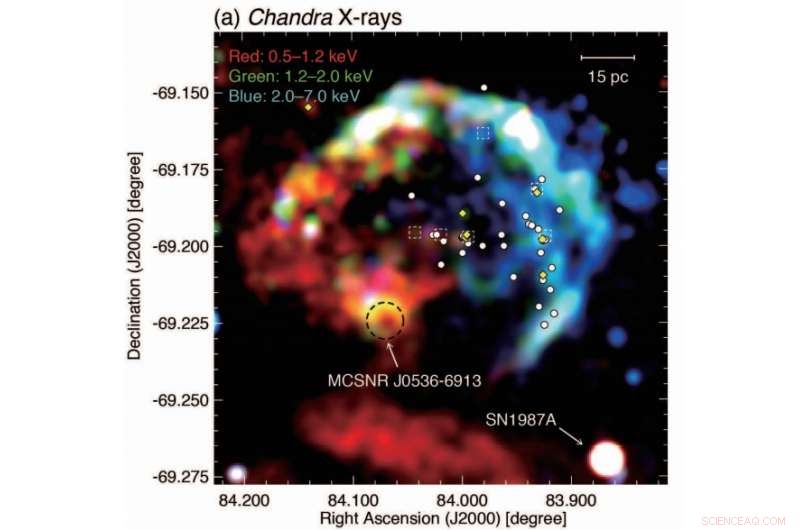
RGB image of the superbubble 30 Doradus C observed by Chandra (Bamba et al. 2004). The red, green, and blue colors represent the energy bands, 0.5–1.2, 1.2–2.0, and 2.0–7.0 keV, respectively. Credit: Sano et al., 2017.
(Phys.org)—An international team of astronomers has uncovered molecular and atomic gas clouds associated with the superbubble known as 30 Doradus C, which is located in the Large Magellanic Cloud (LMC). The findings were presented Jan. 8 on the arXiv pre-print repository.
Called superbubble or supershell, 30 Doradus C is a bright X-ray cavity in the LMC with a diameter of approximately 300 light years. Although it was well studied at different wavelengths that revealed its shell-like morphology and the presence of six stellar clusters, the interstellar gas associated with this superbubble has not been thoroughly investigated yet.
Due to its proximity and face-on inclination to Earth, LMC serves as an excellent laboratory for studying various types of shells and their environments. This galaxy offers a great opportunity to observe interactions between shockwaves and the ambient interstellar gas, which could help scientists to better understand the origins of high energy radiation and cosmic-ray acceleration in supernova remnants.
An observational campaign to investigate these interactions was carried out between July 2014 and April 2015 by a team of researchers led by Hidetoshi Sano of the Nagoya University in Japan. The scientists used the Mopra 22-m radio telescope of the Australia Telescope National Facility to observe the 2.6-mm CO line emission at 115 GHz, and analyzed the 21-cm HI lines toward 30 Doradus C.
"We analyzed the 2.6 mm CO and 21 cm HI lines toward the Magellanic superbubble 30 Doradus C, in order to reveal the associated molecular and atomic gas," the paper reads.
In result, the researchers found five CO clouds distributed along the non-thermal X-ray shell in the west and three HI clouds located at the northwest, southwest and southeast. They also noted that thermal X-rays are brighter in the eastern shell, where there are no dense CO and HI clouds, while the western shell has these dense clouds and no evidence for thermal X-rays.
The team assumes that it is likely that the non-thermal shell was created by multiple supernova remnants during the last few thousand years. Moreover, the observations revealed that the non-thermal X-rays are clearly enhanced around the molecular clouds, what allowed the researchers to draw conclusion that it is a possible evidence for magnetic field amplification via the shock-cloud interaction.
"The large velocity difference between the CO cloud surroundings and the inter-cloud space will enhance turbulence and magnetic field strength via the shock-cloud interaction. According to the three-dimensional magnetohydrodynamic simulations, the magnetic field strength will be amplified up to mG," the scientists wrote in the paper.
The researchers hope that further radio observations will reveal the interstellar molecular and atomic gas distributions at higher resolution as well as the details of the shock-cloud interaction. They also noted that future studies of 30 Doradus C with the Cherenkov Telescope Array will detect and resolve gamma-ray flux associated with the molecular cloud what should enable probing the allow diffusion of cosmic-rays into the associated dense interstellar medium.
© 2017 Phys.org