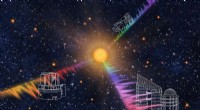
Using computer simulations, a team of researchers led by scientists at the University of Cambridge explored how supermassive black holes grew rapidly during the early stages of the universe, when the first stars and galaxies were beginning to form. They simulated the conditions of the early universe, focusing on the interactions between dark matter, gas, and black holes.
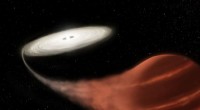
The simulations showed that the first quasars formed from pristine gas in a process called "cold accretion." In cold accretion, gas cools down as it falls onto a supermassive black hole, forming a dense disk of gas around the black hole. This disk becomes unstable and fragments, leading to the formation of massive clumps of gas that further collapse under their gravity.
As these clumps of gas fall toward the black hole, they heat up due to friction and release enormous amounts of energy in the form of radiation, creating a quasar. The energy output of these quasars is so powerful that it can outshine entire galaxies.
The researchers found that the formation of the first quasars was influenced by several factors, including the mass of the supermassive black hole, the amount of gas available for accretion, and the density of dark matter in the surrounding region. They showed that the combination of these factors created favorable conditions for the rapid growth of supermassive black holes and the formation of quasars in the early universe.
The study also suggests that the first quasars could play an important role in the evolution and ionization of the universe. The intense radiation emitted by quasars can heat and ionize the surrounding gas, contributing to the ionization of the intergalactic medium (IGM) and the formation of the first stars and galaxies.
Dr. Yuval Birnboim, from the Institute of Astronomy at Cambridge and the lead author of the study, said, "Our simulations provide a tantalizing glimpse into the cosmic dawn, when the first quasars illuminated the universe. Understanding the formation of these powerful objects is crucial for unraveling the mysteries of galaxy formation and the early universe."
By uncovering the formation mechanism of the first quasars, the research team has provided valuable insights into the early stages of the universe and the evolution of supermassive black holes. The findings deepen our understanding of the complex processes that shaped the universe we observe today.