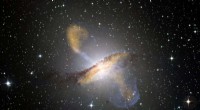
The model simulates what is known as a "tidal disruption event," where a star passing too close to a supermassive black hole is ripped apart by the intense gravitational forces. This process generates a bright flare that can be observed across the electromagnetic spectrum, but the exact mechanisms behind the flare's emission and evolution have remained unclear.
The new model, published in the journal "Monthly Notices of the Royal Astronomical Society," addresses this uncertainty by incorporating various physical processes that occur during the tidal disruption event:
1. Stellar Disruption and Accretion Disk Formation: The model starts with the star's outermost layers being stripped away, forming a debris stream that spirals inward toward the black hole. This stream of material then settles into an accretion disk around the black hole.
2. Shocks and Thermal Emission: As the debris stream falls toward the black hole, it encounters strong shocks that heat the gas to extremely high temperatures. This generates intense thermal emission, which contributes significantly to the observed optical and ultraviolet radiation during the tidal disruption event.
3. Jet Formation and Gamma-ray Emission: The accretion disk formed around the black hole is unstable and prone to launching powerful jets of matter. These jets, driven by magnetic forces, produce gamma-ray emission that is often detected in tidal disruption events. The model includes detailed calculations of these jet formation and emission processes.
4. Disk Evolution and Variability: The model tracks the temporal evolution of the accretion disk as it undergoes significant changes during the tidal disruption event. The disk's properties, such as density and temperature, evolve, leading to variations in the observed emission over time. This explains the observed light curves and spectral features of tidal disruption events.
The new model provides a comprehensive framework that explains many of the observed features of tidal disruption events, such as the bright flares, variable emission, and multi-wavelength observations. It also offers predictions that can be tested through further observations and theoretical studies:
1. Thermal Emission Signatures: The model predicts specific thermal emission signatures arising from the shocked debris stream, which could be detected with future space-based observatories.
2. Jet Properties: The model makes predictions about the properties of jets launched during tidal disruption events, including their opening angles and lifetimes, which can be probed with radio and X-ray observations.
3. Disk Accretion and Variability: The model's predictions regarding the evolution of the accretion disk can be further tested by monitoring tidal disruption events over time and studying their variability patterns.
The new model represents a significant step forward in our understanding of tidal disruption events and provides valuable tools for interpreting future observations of these fascinating astrophysical phenomena. It highlights the interplay between gravitational physics and high-energy astrophysics in the extreme environments near supermassive black holes.