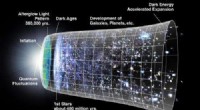
According to the theory of cosmic inflation, the universe underwent a rapid and exponential expansion during a brief period shortly after the Big Bang. This expansion stretched and smoothed out the initial irregularities in the density of matter, leaving behind tiny quantum fluctuations that acted as seeds for the growth of structures in the universe.
As the universe continued to expand and cool, these quantum fluctuations began to grow under the influence of gravity. Over time, they gradually collapsed and condensed, forming dense regions known as protogalactic clouds. These clouds further fragmented into smaller clumps that eventually evolved into galaxies and galaxy clusters.
The presence of quantum fluctuations provided a mechanism for the early universe to break the perfect symmetry and homogeneity that would have otherwise existed. These fluctuations acted as initial perturbations that triggered the gravitational collapse and hierarchical clustering of matter, eventually leading to the formation of massive galaxy clusters that we observe today.
Therefore, quantum fluctuations in the early universe are considered a key factor in explaining the origin and evolution of large-scale structures like galaxy clusters and superclusters.