Gravitational waves are so tiny that they can only be detected by the most sensitive instruments. LIGO's detectors are located in Hanford, Washington, and Livingston, Louisiana. Each detector consists of two 4-kilometer-long arms that are perpendicular to each other. When a gravitational wave passes through the detector, it causes the arms to lengthen and shorten by an infinitesimal amount. This motion is detected by lasers that are reflected back and forth between mirrors at the ends of the arms.
The first gravitational wave that LIGO detected was created by the collision of two black holes, each with a mass about 30 times that of the sun. The collision released more energy than the entire visible universe in a matter of milliseconds. The gravitational waves from this event were so strong that they caused the LIGO detectors to vibrate by a fraction of a proton's width.
LIGO's detections have opened up a new window on the universe. Astronomers are now using gravitational waves to study black holes, neutron stars, and other compact objects. Gravitational waves could also provide insights into the early universe, just moments after the Big Bang.
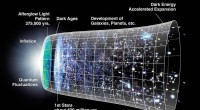
One of the most exciting possibilities is that gravitational waves could reveal the first minute of the universe. This era is known as the Planck epoch, and it is thought to have lasted for only 10^-43 seconds. During the Planck epoch, the universe was so hot and dense that matter and energy were indistinguishable. Gravitational waves from this era could provide a glimpse of the conditions that existed at the beginning of time.
LIGO is currently undergoing an upgrade that will make it even more sensitive to gravitational waves. The upgraded LIGO is expected to begin operations in 2023. With the upgraded LIGO, astronomers hope to detect gravitational waves from even more distant and powerful events. They may even be able to catch a glimpse of the first minute of the universe.