1. Observing Accretion Disks: Black holes often have an accretion disk, a swirling disk of gas and matter that is heated to extremely high temperatures as it falls towards the black hole. This accretion disk emits intense radiation, including X-rays and visible light, which can be detected by telescopes.
2. Gravitational Lensing: Massive objects like black holes can distort the light of background stars or galaxies due to their gravitational pull. This phenomenon, called gravitational lensing, can be observed and analyzed to infer the presence of a black hole.
3. Jet Formation: In some cases, black holes can launch powerful jets of particles and energy due to the infalling matter. These jets can be observed in radio and X-ray wavelengths, providing additional evidence for the presence of a black hole.
4. Spectroscopic Observations: When matter falls into a black hole, it can emit specific patterns of light, known as emission lines. By analyzing the spectrum (the range of wavelengths of light) emitted by the region near the black hole, astronomers can sometimes infer the existence of a black hole.
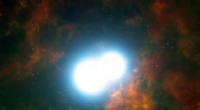
5. Variable Light Curves: When a black hole is close to another star or companion object, its gravitational influence can cause the companion object to exhibit regular variations in brightness. Observing and analyzing these variations can help identify the presence of a black hole.
6. Radio and Infrared Observations: Black holes themselves do not emit light, but the matter surrounding them can emit radiation in the radio and infrared parts of the spectrum. By using radio and infrared telescopes, astronomers can detect these emissions and infer the presence of a black hole.
7. X-ray and Gamma-ray Observations: Black holes and their accretion disks can emit high-energy radiation, including X-rays and gamma rays, which can be detected by specialized telescopes and satellites.
8. Direct Imaging (Event Horizon Telescope): In 2019, astronomers achieved a major milestone by obtaining the first-ever direct image of a black hole using the Event Horizon Telescope (EHT), an array of radio telescopes working in concert. The EHT allowed scientists to capture an image of the supermassive black hole at the center of the galaxy M87.
9. Tidal Disruption Events (TDEs): When a star gets too close to a supermassive black hole, the black hole's gravitational forces can disrupt the star, leading to a powerful flare or transient brightening event. By observing TDEs, astronomers can infer the presence of supermassive black holes.
It's worth noting that observing and identifying black holes can be very challenging due to their nature. Many of the detection techniques rely on indirect observations and inferences, and confirmation of the presence of a black hole often requires multiple lines of evidence and thorough analysis of data.