How do stars form?
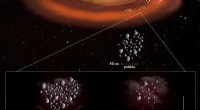
Stars are born within vast clouds of interstellar gas and dust called nebulae. When a region within a nebula becomes gravitationally unstable, it begins to collapse under its own gravity. As it contracts, the density and pressure of the gas increase, leading to the formation of a protostar.
At the heart of the protostar, where the temperature and pressure become extremely high, nuclear fusion ignites. This is the moment a protostar evolves into a full-fledged star.
Nuclear Fusion in Stars
In the cores of stars, the immense temperature and pressure cause hydrogen atoms to fuse together, releasing vast amounts of energy. This energy production through nuclear fusion powers the star.
As the hydrogen fuel gets exhausted in the core, heavier elements, such as helium, are created through successive fusion reactions. The star continues to burn these heavier elements in concentric shells as it evolves through various stages of its life cycle.
The Main Sequence
The majority of stars spend most of their lives in a phase known as the "main sequence." During this stable stage, the energy generated through nuclear fusion balances out the star's gravitational collapse.
Depending on their mass, stars can be classified into different categories, each with its own characteristics and lifespan.
- Red Dwarfs: These are small, cool, and dim stars that emit a faint reddish light. They have very low mass and can burn hydrogen for trillions of years, even longer than the current age of the universe.
- Yellow Dwarfs: Yellow dwarfs, like our own Sun, are mid-sized stars with moderate temperatures. They burn hydrogen over billions of years but eventually become red giants as they evolve.
- Supergiants: Supergiants are extremely massive stars that burn their fuel rapidly and have relatively short lifespans. They undergo substantial mass loss and often end their lives in spectacular supernova explosions.
- Neutron Stars and Black Holes: The final fate of massive stars depends on their remaining mass after burning through their nuclear fuel. Some become neutron stars – incredibly dense stellar cores primarily made of neutrons – while others collapse into black holes, regions of overwhelming gravitational force from which nothing can escape, not even light.
The Importance of Stars
Stars are crucial for life as we know it. They provide the energy needed for photosynthesis, driving ecosystems and sustaining the web of life on Earth.
Beyond their role in planetary systems, stars also contribute to the chemical enrichment of the universe. As stars evolve, they release heavy elements into space, replenishing the interstellar medium from which new stars and planetary systems can form.
The study of stars – their formation, evolution, and characteristics – is a fundamental part of astrophysics and has significantly expanded our understanding of the universe.