Here's a more detailed explanation of this hypothesis:
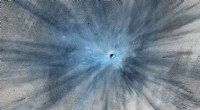
1. Early Earth Impacts: During the early stages of Earth's formation, known as the Hadean Eon (about 4.6 billion years ago), the Earth was frequently hit by large asteroids and comets. These impacts were common occurrences and played a significant role in shaping the planet's features.
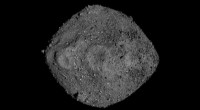
2. Giant Asteroid Collisions: Among these impacts, some involved giant asteroids that were several times larger than what we consider large asteroids today. These asteroids, potentially as massive as planets like Mars, would have had a tremendous impact on the Earth.
3. Fragmentation and Debris: When these giant asteroids collided with Earth, they were thought to have shattered into numerous smaller fragments. These fragments, along with the original asteroid's material, would have been ejected into space.
4. Reaccumulation: As the debris and fragments from the asteroid impacts circled the Earth, they slowly reaccumulated, forming larger bodies of rock and debris. Over time, these larger bodies coalesced into the continental masses we see today.
5. Crust Formation: The intense heat generated by the collisions, as well as the gravitational forces involved, would have led to the melting and solidification of the Earth's crust. The solidification of this molten material resulted in the formation of various rock types that make up the continents.
6. Continental Drift: After the formation of the continents, they were not fixed in place but rather underwent constant movement due to the Earth's dynamic processes. The continental drift, driven by plate tectonics, shaped the continents' current positions and configurations.
This theory of asteroid-driven continent formation is still being studied and debated by scientists, as it presents an alternative explanation to the traditional understanding of continental formation through tectonic processes and the Earth's internal dynamics. Further research and evidence are needed to fully validate or refine this hypothesis.