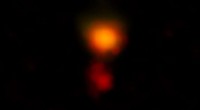
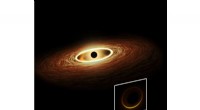
Observations made with the Atacama Large Millimeter/submillimeter Array (ALMA), along with theoretical modeling, show that the small celestial objects that make up the Kuiper Belt, a vast collection beyond the orbit of Neptune, are affected by a phenomenon previously only suggested in computer simulations.
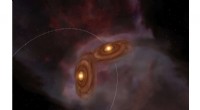
When a planet moves throughout a protoplanetary disk, it clears a gap and concentrates rocky debris to its outer and inner rims to create a gap in the small icy bodies beyond Neptune. This gap is known as a "depleted zone," and the process that creates the gap was previously seen in computer models. However, new observations from ALMA show that the process might be much stronger and more prevalent in our own solar system than scientists had predicted.
The research, led by astronomers from the University of Tokyo and Osaka Sangyo University, is presented in the journal Nature.
"We had previously suspected that this mechanism was at play, but the resolution and sensitivity of ALMA make this the first direct detection of the effect in our own solar system," says lead author Shingo Kameda of the University of Tokyo.
Previous studies have shown that the outer edge of the Kuiper Belt is sharply limited by the presence of Neptune. However, the new ALMA observations show the same process, although weaker, also occurs on the inner edge.
"This shows that even though the large planets stopped migrating some 4 billion years ago, their effects on the distribution of small bodies are still detectable today," says co-author Takahiro Sudo of Osaka Sangyo University.
These results help to reconcile observations with theoretical predictions of the formation of the Kuiper Belt.
The researchers found that the observed depleted zone in the Kuiper Belt is consistent with the predictions of a specific theoretical model of planetary migration, in which the gas disk exerts a drag force on the planets, making them migrate while interacting with the solids, which are concentrated in narrow zones.
"This result implies that the solid particles piled up in the narrow zones were directly scattered by the planets, not affected indirectly through the disk gas. This mechanism may be one cause of the diversity in the physical and chemical properties of small bodies in the solar system," says co-author Motohide Tamura, a professor at the University of Tokyo.