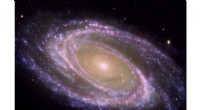
Galaxy mergers are the key to the formation of massive elliptical galaxy and they may also have played an important role in the early Universe to explain the observed abundance of giant compact elliptical galaxies. Studying the properties of galaxies in the nearby universe can help us understand the properties of the early Universe
The merging process is complex, and the effects on the gas, stars and dark matter of the galaxies are still under study.
The main features of galaxy mergers can be summarized as follows:
The total amount of mass and angular momentum is conserved in the merging system.
The initial gas distribution settles because of dynamical friction.
Stellar motions are dynamically heated at the interaction radius and the merging time.
The star formation rate increases in the nuclear regions because the gas is funneled towards the center.
Star formation may also happen in other places, e.g., in tails or bridges.
The morphology and the dynamics of the remnant system depend on the orbital parameters and gas fractions of the progenitors.
Merging events are a common occurrence in the local Universe. Although pure gas-rich mergers are less frequent, some observational evidence support them; for example, ultraluminous infrared galaxies that are thought to be the result of gas rich-rich mergers.