Perseverance is equipped with a variety of instruments that will help it search for evidence of past life, including a drill that can collect samples of rock and soil, a microscope that can analyze those samples, and a spectrometer that can detect the presence of organic molecules.
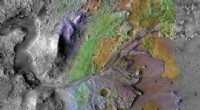
The rover will spend the next two years exploring Jezero crater, looking for signs of life that may have existed billions of years ago. If Perseverance is successful, it will provide strong evidence that Mars was once a habitable planet, and it could help us to understand the origins of life in the solar system.
Here are some of the key instruments that Perseverance will use to search for signs of life on Mars:
* The Mars Hand Lens Imager (MAHLI) is a high-resolution camera that can take close-up images of rocks and soil. This camera will be used to document the geology of Jezero crater and to identify potential samples for further analysis.
* The Scanning Habitable Environments with Raman and Luminescence for Organics and Chemicals (SHERLOC) instrument is a spectrometer that can detect the presence of organic molecules in rocks and soil. Organic molecules are essential building blocks of life, and their presence on Mars would be a strong indication that the planet was once habitable.
* The Planetary Instrument for X-ray Lithochemistry (PIXL) instrument is a spectrometer that can analyze the elemental composition of rocks and soil. This information will help scientists to understand the geological history of Jezero crater and to identify potential samples for further analysis.
* The Perseverance Drill is a robotic drill that can collect samples of rock and soil from the surface of Mars. These samples will be sealed in tubes and returned to Earth for further analysis.
Perseverance's mission to Mars is a major milestone in the search for extraterrestrial life. If the rover is successful, it will provide strong evidence that Mars was once a habitable planet, and it could help us to understand the origins of life in the solar system.