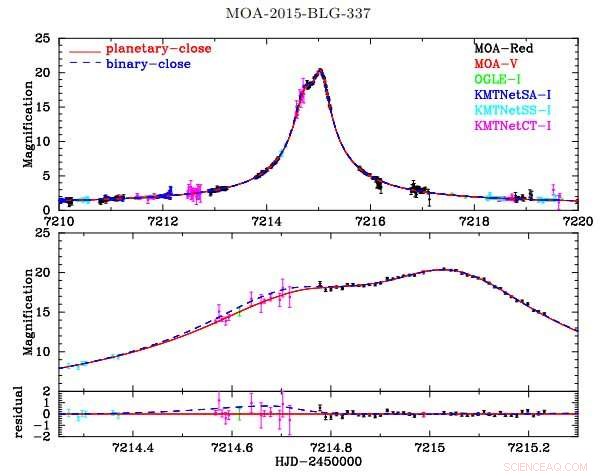
The light curve of MOA-2015-BLG-337. The top, middle and bottom panels show the entire period of the event, close-up of the anomaly and the residual from the best fitting planetary-close model, respectively. The red solid line and blue dashed line indicate the best planetary-close model and the best binary-close model. The binary model deviates from the planetary model particularly between 7214.5 < HJD − 2450000 < 7214.8. The large photometric uncertainties in this period make it difficult to distinguish which is the best-fit model. The B&C data are not shown for clarity because of their large error bars while these data are used in the analysis. Credit: Miyazaki et al., 2018.
Using gravitational microlensing technique, an international group of astronomers has found a new substellar system whose composition remains a puzzle. The newly detected system, designated MOA-2015-BLG-337L, may consists of a planet orbiting a low-mass brown dwarf or may be composed of two brown dwarfs. The finding is detailed April 3 in a paper published on arXiv.org.
Based on the gravitational lens effect, the microlensing method is mainly used to detect planetary and stellar-mass objects regardless of the light they emit. This technique is sensitive to low-mass planets orbiting relatively faint host stars like M dwarfs or brown dwarfs. Therefore, microlensing can play an important role for understanding the formation of very low mass stars and brown dwarfs by detecting companions of low-mass hosts.
A team of astronomers, including the Microlensing Observations in Astrophysics (MOA), the Optical Gravitational Lensing Experiment (OGLE) and the Korea Microlensing Telescope Network (KMTNet) Collaboration, has employed this method to detect a new system composed of at least one brown dwarf. The researchers have analyzed the microlensing event MOA-2015-BLG-337, first observed by MOA using the 1.8 m MOA-II telescope at Mount John University Observatory (MJUO) in New Zealand. The analysis resulted in a discovery of a new system designated MOA-2015-BLG-337L.
"In this paper, we report the discovery and present the analysis of the short-timescale binary microlensing event, MOA-2015-BLG-337. We find two competing models that explain the observed data. One comprises a planetary mass-ratio lens system and the other, a binary mass ratio lens system," the researchers wrote in the paper.
The first scenario explaining the observational data proposed by the team suggests that MOA-2015-BLG-337L is composed of a brown dwarf with a mass between 6.3 and 29.3 Jupiter masses orbited by a planet dozens of times more massive than the Earth (between 21.6 and 100.7 Earth masses). According to the estimates, the planet should be circling its host at a distance of approximately 0.25 AU.
The other hypothesis proposed by the researchers implies that the newly found system is a brown dwarf binary in which one component has a mass within the range of about 64 to 78 Jupiter mass and its companion has a mass between 11.4 and 18.3 Jupiter masses. The astronomers noted that the two objects are most likely separated from each other by 0.19 as well as 3.3 AU.
"We find two competing models that explain the observed data. One comprises a planetary mass-ratio lens system and the other, a binary mass ratio lens system," the paper reads.
The researchers concluded that analysing such events as MOA-2015-BLG-337 is important for the study of planetary formation in very low-mass objects. However, they added that much more research is required to improve existing knowledge in this field. For instance, the astronomers hope that future microlensing surveys, like the PRime-focus Infrared Microlensing Experiment (PRIME), will reveal the frequency of exoplanets around low-mass brown dwarfs and even the frequency of planetary mass objects orbited by exo-moons.
© 2018 Phys.org