The signal that the astronomers were looking for is called the redshifted 21-centimeter line, which is emitted by neutral hydrogen gas. This gas was very common in the early Universe, before stars and galaxies had a chance to form and convert the hydrogen into other elements. By detecting the 21-centimeter line, astronomers can learn about the properties of the neutral hydrogen gas and the conditions in the early Universe.
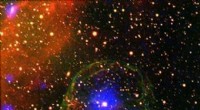
In this case, the astronomers were looking for the 21-centimeter line from a galaxy called MACS1149-JD1, which is the most distant galaxy known to date. The galaxy is so far away that its light has been traveling for 13.4 billion years to reach Earth. By the time the light from MACS1149-JD1 was emitted, the Universe was only 500 million years old.
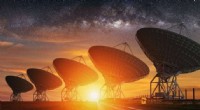
ALMA is the most powerful telescope in the world for studying the 21-centimeter line. However, even ALMA could not detect the signal from MACS1149-JD1. This means that the neutral hydrogen gas in the galaxy must be very cold and dense. The astronomers estimate that the gas temperature is only 20 Kelvin (about -253 degrees Celsius), and the density is about 100 times higher than the density of hydrogen gas in the Milky Way galaxy.
The non-detection of the 21-centimeter line from MACS1149-JD1 provides important information about the properties of the first galaxies. It suggests that these galaxies were very cold and dense, and that they were not yet forming stars. This information helps astronomers to understand how galaxies evolved in the early Universe.