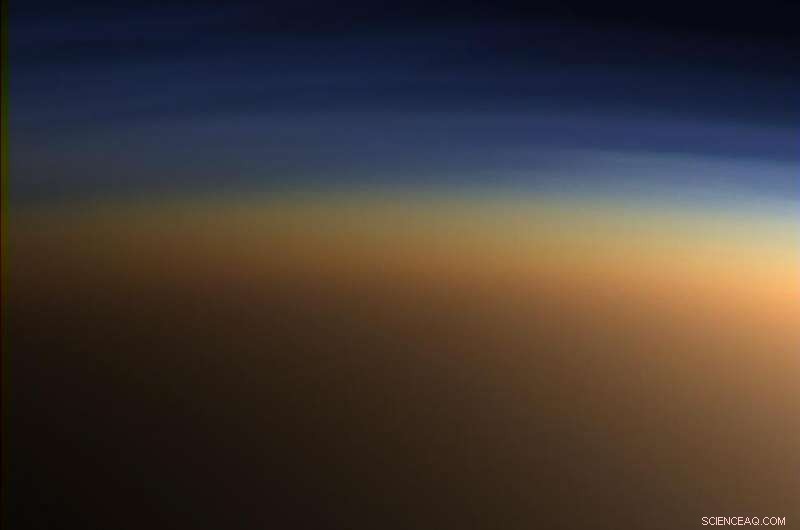
True-color image of layers of haze in Titan's atmosphere. Credit: NASA
(Phys.org)—A team of researchers from several institutions in France and Mexico has developed computer models that simulate conditions on Saturn's largest moon Titan showing that some of the islands on the planet's surface may be made of bubble streams. In their paper published in the journal Nature Astronomy, the team describes how they built their model and explain how bubble streams could form on the surface of Titan.
Prior research has suggested that the seas that exist on Titan are likely made of methane at or near the surface and ethane at greater depth and that the moon's atmosphere is likely mostly nitrogen. Also, prior research that involved studying images sent back by the Cassini space probe showed islands in some of the moon's seas appearing and disappearing over time. Study of such islands showed that they were not due to changes in sea levels, which led some to theorize that they were maybe nothing more than areas where bubbles were bursting as they percolated up from below. In this new effort, the researchers built computer models to find out if bubbles really could be the cause of the mysterious islands.
To create their computer models, the researchers input data regarding Titan's makeup and also used data supplied by oil and gas companies that describe the way underground fluids behave under great pressure here on Earth.
The researchers report that their models showed that the islands could, indeed, be bubble streams, and offer an explanation of how it could happen. They suggest factors on Titan such as tides, wind or even changes in atmospheric temperatures could cause nitrogen from the atmosphere to mix with methane from the surface, which would then be pushed down into pools of ethane—the difference in pressure at varying depths would force the components to separate, causing the formation of nitrogen gas bubbles, which would naturally rise back up to the surface. They note also that such bubbles would be very reflective, which would explain why they would be picked up by Cassini's sensors.
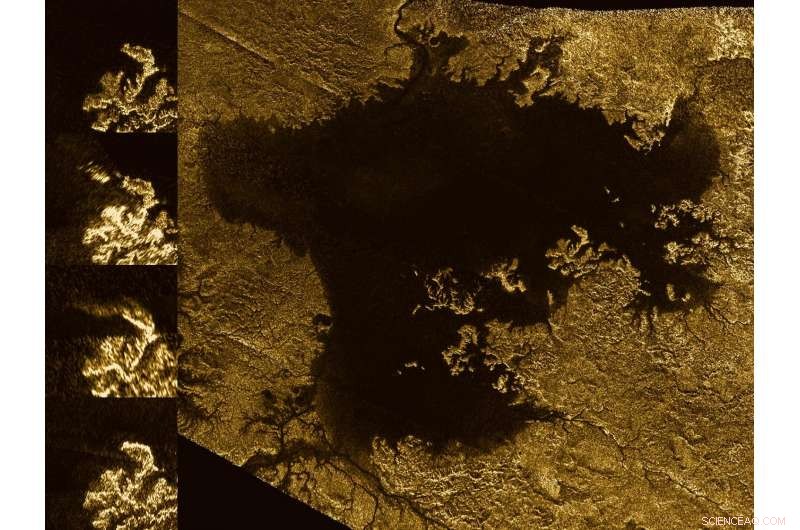
Radar images from Cassini showed a strange island-like feature in one of Titan's hydrocarbon seas that appeared to change over time (series of images at left). Credits: NASA/JPL-Caltech/ASI/Cornell
It has been noted that if the bubble theory is correct, it would mean having to design a subsurface vehicle to deal with them if such a probe were ever sent to Titan.
© 2017 Phys.org