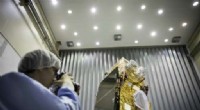
The Mars Odyssey spacecraft was launched on April 7, 2001, and it arrived at Mars on October 24, 2001. The spacecraft entered orbit around Mars at an altitude of about 400 kilometers. The orbiter has a mass of about 3,300 kilograms, and the gamma-ray spectrometer has a mass of about 50 kilograms.
The Mars Odyssey spacecraft has been in orbit around Mars for over 20 years, and it has made a significant contribution to our understanding of the planet. The orbiter has mapped the Martian surface in great detail, and the gamma-ray spectrometer has measured the radioactivity of the Martian crust. These data have helped us to learn about the geology, the history, and the composition of Mars.
Here are some of the key findings of the Mars Odyssey spacecraft:
* The Martian surface is covered in a layer of dust that is about 1 meter thick.
* The Martian crust is composed of a variety of rocks, including basalt, andesite, and granite.
* The Martian surface is relatively radioactive, due to the presence of thorium, uranium, and potassium.
* There is evidence of past volcanic activity on Mars.
* There is evidence of past water activity on Mars.
The Mars Odyssey spacecraft is continuing to orbit Mars and to make observations of the planet. These observations are helping us to learn more about Mars, and they are providing valuable clues to the history and evolution of the planet.