How does dark matter work?
Dark matter is thought to be made up of particles that are much smaller than protons and neutrons. These particles are called weakly interacting massive particles (WIMPs). WIMPs are so small and weakly interacting that they can pass through normal matter without being detected.
Dark matter and gravity
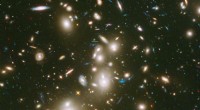
Dark matter's gravity is what holds galaxies together. Without dark matter, galaxies would be too spread out to exist. Dark matter also helps to explain the motions of stars within galaxies.
Dark matter and the Big Bang
Dark matter is thought to have been created in the Big Bang, along with the rest of the universe. However, we don't know exactly how dark matter was created.
Dark matter and the future of the universe
Dark matter is thought to play a role in the future evolution of the universe. Some scientists believe that dark matter could eventually cause the universe to collapse in on itself. Others believe that dark matter could help to prevent the universe from expanding too quickly.
The search for dark matter
Scientists are currently searching for dark matter using a variety of methods. One method is to look for WIMPs in underground laboratories. Another method is to look for the effects of dark matter on visible matter.
The search for dark matter is one of the most important and challenging problems in physics today. If we can find dark matter, we will learn a great deal about the universe and its history.