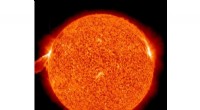
In a recent study, a team of scientists investigated the relationship between the Sun's magnetic activity and the determination of its seismic age. Seismic age refers to the age of the Sun inferred from the analysis of its seismic waves. These waves, which are caused by the Sun's internal oscillations, provide insights into the Sun's internal structure and dynamics.
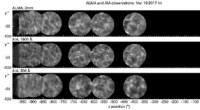
The research team analyzed seismic data obtained from helioseismic observations, which allow scientists to study the Sun's interior through the detection and analysis of its seismic waves. They focused on the Sun's far side, which is not visible from Earth and has received less attention in previous seismic studies.
By comparing the seismic data with the Sun's magnetic activity measurements, the scientists found that the magnetic field strength in the Sun's active regions significantly influences the determination of its seismic age. They observed that during periods of high magnetic activity, the Sun's seismic age appeared younger than during periods of low magnetic activity.
According to the study's findings, the magnetic field in active regions alters the speed at which seismic waves propagate through the Sun's interior. This means that the magnetic activity affects the Sun's seismic structure, which can lead to variations in the resulting seismic age estimates.
The researchers emphasize the importance of considering the Sun's magnetic activity when analyzing its seismic data and interpreting the seismic age. By taking into account the influence of magnetic activity, scientists can obtain more accurate and reliable estimates of the Sun's internal age and dynamics.
This study deepens our understanding of the intricate relationship between the Sun's surface activity and its internal structure. It also highlights the value of helioseismic observations in probing the Sun's interior and unraveling its complex behavior. Further studies in this area will help us better understand the Sun's evolution, dynamics, and long-term behavior.