Over the past 60 years, humans have begun to explore our solar system in earnest. From the first launches in the late 1950s until today, we've sent probes, orbiters, landers and even rovers (like NASA's Perseverance Rover that touched down on Mars in February 2021) to every planet in our solar system. But can you name all eight of those planets? (Yes, there's only eight – not nine. Pluto got "demoted" in 2006.) And can you put them in the correct order?
In case you're a little rusty, we'll break down some common ways to order the planets plus a few tricks to help you remember them going forward. Let's start with distance from the sun.
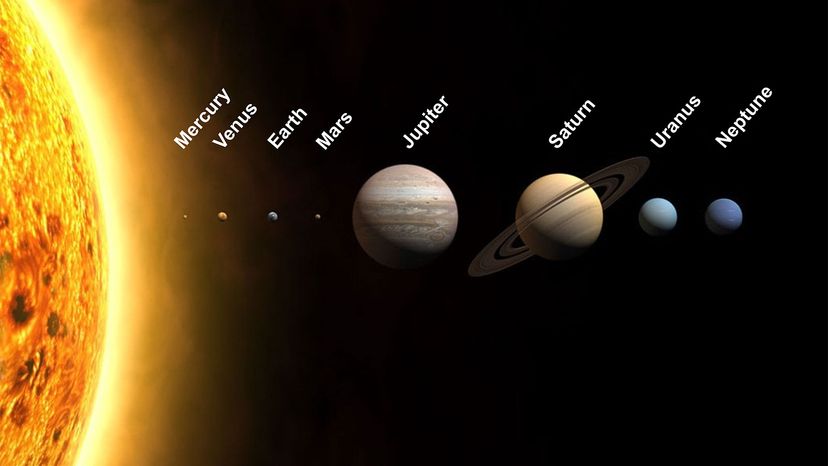
The most common way to order the planets is by their distance from the sun. Using this method, the planets are listed in the following order:
AU stands for astronomical units – it's the equivalent to the average distance from Earth to the sun (which is why Earth is 1 AU from the sun). It's a common way astronomers measure distances in the solar system that accounts for the large scale of these distances. To put it another way, Mercury, which is closest, is 35.98 million miles from the sun, while Neptune, the farthest, is 2.79 billion miles from the sun. Earth is 92.96 million miles from the sun.
There are many handy expressions to remember the order of the planets. These are typically mnemonics which use the first letter of each planet's name to come up with a phrase that's easier to remember.
Here are some of the most common (and silliest) ones:
In each case, "M" stands for "Mercury," "V" for "Venus," and so on. You can also try to remember them with a few rhyming verses:
Amazing Mercury is closest to the Sun,Finally, if you are musically inclined, there are a few songs that may help you remember. Two popular ones are Mr. R's Planet Song and The Planet Song from Kids Learning Tube.
While most people want to know the order of the planets by distance, there are other ways to order the planets that you might be curious about.
For example, if you order the planets by size (radius) from biggest to smallest, then the list would be:
Or you could order the planets by weight (mass). Then, the list from most massive to least massive would be: Jupiter (1.8986 x 1027 kilograms), Saturn (5.6846 x 1026 kg), Neptune (10.243 x 1025 kg), Uranus (8.6810 x 1025 kg), Earth (5.9736 x 1024 kg), Venus (4.8685 x 1024 kg), Mars (6.4185 x 10²³ kg), and Mercury (3.3022 x 10²³ kg). Interestingly, Neptune has more mass than Uranus, even though Uranus is larger! Scientists can't put a planet on a scale, so to determine mass, they look at how long it takes nearby objects to orbit the planet and how far from the planet those objects are. The heavier the planet, the stronger it pulls on nearby objects.
Finally, a fun way to order the planets is by the number of moons they have. We'll start with the planet that has the most:
(Note that these numbers include provisional moons that are still being confirmed by astronomers.)
In short, there are a number of ways to order and reorder the planets based on different facts about them; as long as you remember there are eight in total, that's what counts. (Sorry, Pluto!)
Now That's InterestingSpeaking of Pluto, what's the deal? After its discovery in 1930, Pluto was classified as a planet. However, in 2006, the International Astronomical Union downgraded Pluto from "planet" to "dwarf planet." This is because the definition of a planet means that it has cleared its orbit of other objects (which Pluto has not done, as it shares its space with many Kuiper Belt objects). Pluto is one of five dwarf planets in our solar system – and it's not even the largest one (that's Eris).
ScienceAstronomy TermsFloating PlanetScienceAstronomyHow Nomad Planets WorkScienceSpace ExplorationHow Planet Hunting WorksScienceThe Solar SystemWhy is Pluto no longer considered a planet?ScienceFuture SpaceHow Will We Colonize Other Planets?ScienceGeophysicsHow much does planet Earth weigh?ScienceThe Solar SystemWhy Did It Take So Long to 'Discover' Planet Nine?ScienceThe Solar SystemWhat's the Order of the Planets in the Solar System?ScienceThe Solar SystemDoes it rain on other planets?ScienceThe Solar SystemJupiter: Yokozuna of Gas Giants, Banisher of PlanetsScienceThe Solar SystemHow do planets form?ScienceStarsWhite Dwarfs Can Shred Planets to PiecesScienceThe Solar SystemWho Named Planet Earth?ScienceSpace ExplorationDoes a planet need continents to support life?ScienceThe Solar SystemIs Planet Nine Actually a Primordial Black Hole?ScienceSpace ExplorationHow many planets in our universe could support life?ScienceStarsCould a planet exist without a host star?ScienceThe Solar SystemWhy Are Planets Almost Spherical?ScienceThe Solar SystemNASA Announces New Solar System Packed With Seven PlanetsScienceThe Solar SystemPluto: Is It a Planet After All?ScienceThe Solar SystemHaumea, a Dwarf Planet in the Kuiper Belt, Has Its Own RingScienceSpace ExplorationNew NASA Satellite Is Hunting for Distant PlanetsScienceThe Solar SystemAncient Obliteration of Dwarf Planets May Have Created Saturn's RingsScienceThe Solar SystemIs Earth the Only Planet With Tectonic Plates?ScienceStarsHow do astronomers detect that a star has a planet orbiting it?ScienceSpace ExplorationCan we detect water on exoplanets?ScienceThe Solar SystemThe Truth Behind the Rogue Planet NibiruScienceThe Solar SystemUranus: The Planet on a Very Tilted AxisScienceThe Solar SystemPloonets: When Moons Become PlanetsScienceAstronomy TermsPlanetariumScienceSpace Exploration10 Remarkable ExoplanetsScienceSpace ExplorationClosest Exoplanet Yet Confirmed By European Southern ObservatoryScienceStarsSpotted: Early Planetary Formation Around a Binary Star SystemScienceStarsThis Is How We'll Detect Life on Distant ExoplanetsScienceSpace ExplorationNASA's Kepler Mission Adds 100 Alien Worlds to Exoplanet TallyScienceSpace ExplorationCan amateur astronomers spot exoplanets?ScienceFuture Space10 Best Ideas for Interplanetary CommunicationScienceSpace ExplorationLISA: Detecting Exoplanets Using Gravitational WavesScienceThe Solar SystemHow NASA Planetary Protection WorksScienceAstronomy TermsPlanetesimal HypothesisEntertainmentMemorable MoviesIn 'Star Wars' Entire Stars and Planets Get Destroyed â Is That Possible?