Although black holes themselves are invisible, their gravitational influence leaves unmistakable fingerprints on nearby matter and light. Astronomers detect them through mass measurements, gravitational lensing, and high‑energy radiation.
In binary systems, the motion of a visible star or a gaseous disk can reveal the presence of an unseen massive companion. By tracking the orbital period, velocity, and radial‑velocity curve, astronomers derive the system’s total mass. If the inferred mass exceeds about three solar masses—well above the maximum for a neutron star— a black hole is the most plausible explanation.
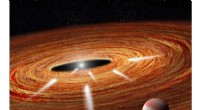
For instance, the core of galaxy NGC 4261 hosts a large, spirally‑shaped disk about the size of our Solar System. Its rotation curve indicates a mass far greater than the Sun’s, pointing to a supermassive black hole lurking within.
Einstein’s General Theory of Relativity predicts that massive objects curve spacetime, bending the path of light. This effect was first confirmed during the 1919 solar eclipse, when starlight was deflected by the Sun’s gravity.
When a massive, otherwise invisible object lies between Earth and a distant source, it can act as a natural telescope, magnifying and duplicating the background light. Such microlensing events were famously observed in the MACHO‑96‑BL5 system, where two closely spaced images appeared in Hubble images, revealing the passage of an unseen lens—most likely a stellar‑mass black hole.
Material falling into a black hole is heated to extreme temperatures, producing copious X‑ray and gamma‑ray emission. The X‑ray binary Cygnus X‑1, powered by its companion HDE 226868, is a textbook example: its accretion disk radiates bright X‑rays detectable by observatories such as NASA’s Chandra X‑ray Observatory.
Supermassive black holes can also launch relativistic jets, emitting strong radio waves. The galaxy M87 hosts such a jet, a hallmark of a black hole billions of solar masses in mass.
It is crucial to remember that black holes are not cosmic vacuum cleaners; they only attract matter that ventures too close. Despite their invisibility, the indirect evidence of their existence is compelling and continues to fuel scientific discovery.