When you look up at the night sky, especially during the summer, you'll see a faint band of stars spread across the entire middle of the sky. This band of stars is our galaxy, the Milky Way. The sun is just one of about 200 billion stars in the Milky Way, which is just one of the billions of galaxies in the universe. A galaxy is a large system of stars, gas (mostly hydrogen), dust and dark matter that orbits a common center and is bound together by gravity -- they've been described as "island universes." Galaxies come in many sizes and shapes. We know that they're very old and formed early in the evolution of the universe. Yet how they formed and evolved into their various shapes remains a mystery.
When astronomers look into the deepest reaches of the universe with powerful telescopes, they see myriads of galaxies. The galaxies are far away from one another and constantly moving away from one another as our universe expands. Furthermore, galaxies are organized into large clusters and other structures, which could have important implications for the overall structure, formation and fate of the universe.
Some galaxies, called active galaxies, emit huge amounts of energy in the form of radiation. They may have exotic structures such as supermassive black holes at their centers. Active galaxies represent an important area of astronomical research.
In this article, we'll find out how galaxies were discovered and what types exist, what they're made of, their internal structures, how they form and evolve, how they're distributed across the universe, and how active galaxies might emit so much energy.
Luminosity-Distance RelationshipAstronomers (professional or amateur) can measure a star's brightness (the amount of light it puts out) by using a photometer or charge-coupled device on the end of a telescope. If they know the star's brightness and the distance to the star, they can calculate its luminosity -- the amount of energy that it puts out (luminosity = brightness x 12.57 x (distance)2). Conversely, if you know a star’s luminosity, you can calculate its distance.
Contents 2008 HowStuffWorks
Galaxies come in a variety of sizes and shapes. They can have as few as 10 million stars or as many as 10 trillion (the Milky Way has about 200 billion stars). In 1936, Edwin Hubble classified galaxy shapes in the Hubble Sequence.
Spiral galaxies have the most complex structures. Here's a view of the Milky Way as it would appear from the outside.
 2008 HowStuffWorks
All of these components orbit the nucleus and are held together by gravity. Because gravity depends upon mass, you might think that most of a galaxy's mass would lie in the galactic disk or near the center of the disk. However, by studying the rotation curves of the Milky Way and other galaxies, astronomers have concluded that most of the mass lies in the outer portions of the galaxy (like the halo), where there is little light given off from stars or gases.
On the next page, we'll take a walk through the history of galaxies.
Let's look at the history of galaxies in astronomy.
There are still many mysteries surrounding galaxy formation, but on the next page we'll explain some of the best theories about it.
Light Years AwayGalaxies are far apart. The Andromeda galaxy, which is also called M31 (Messier object #31), is the closest galaxy to us -- 2.2 million light years away. Astronomers usually measure intergalactic distances in terms of megaparsecs:
one parsec = 3.26 light years
one million parsecs = one megaparsec
one megaparsec (Mpc) = 3.26 million light years
The farthest visible galaxies are approximately 3,000 Mpc away, or about 10 billion light years.
Read More 2008 HowStuffWorks
We really don't know how various galaxies formed and took the many shapes that we see today. But we do have some ideas about their origins and evolution.
Let's look at the period of galaxy formation.
Edwin Hubble's observations, and subsequent Hubble Law (which we'll explain later), led to the idea that the universe is expanding. We can estimate the age of the universe based on the rate of expansion. Because some galaxies are billions of light years away from us, we can discern that they formed fairly soon after the big bang (as you look deeper into space, you see further back in time). Most galaxies formed early, but data from NASA's Galaxy Explorer (GALEX) telescope indicate that some new galaxies have formed relatively recently -- within the past few billion years.
Most theories about the early universe make two assumptions:
From these assumptions, astronomers believe that the denser areas slowed the expansion slightly, allowing gas to accumulate in small protogalactic clouds. In these clouds, gravity caused the gas and dust to collapse and form stars. These stars burned out quickly and became globular clusters, but gravity continued to collapse the clouds. As the clouds collapsed, they formed rotating disks. The rotating disks attracted more gas and dust with gravity and formed galactic disks. Inside the galactic disk, new stars formed. What remained on the outskirts of the original cloud were globular clusters and the halo composed of gas, dust and dark matter.
Two factors from this process might account for the differences between elliptical and spiral galaxies:
 2008 HowStuffWorks
Galaxies do not act alone. The distances between galaxies do seem large, but the diameters of galaxies are also large. Compared to stars, galaxies are relatively close to one another. They can interact and, more importantly, collide. When galaxies collide, they actually pass through one another -- the stars inside don't run into one another because of the enormous interstellar distances. But collisions do tend to distort a galaxy's shape. Computer models show that collisions between spiral galaxies tend to make elliptical ones (so, spiral galaxies probably haven't been involved in any collisions). Scientists estimate that as many as half of all galaxies have been involved in some sort of collision.
Gravitational interactions between colliding galaxies could cause several things:
So, do galaxies just float around in space or does some unseen force regulate their movement? And what happens when they run into each other? Find out on the next page.
 2008 HowStuffWorks
Galaxies aren't randomly distributed throughout the universe -- they tend to exist in galactic clusters. The galaxies in these clusters are bound together gravitationally and influence one another.
When astronomers Margaret Geller and Emilio E. Falco plotted the positions of galaxies and galactic clusters in the universe, it became clear that galactic clusters and superclusters are not randomly distributed. They're actually clumped together in walls (long filaments) interspersed with voids, which gives the universe a cobweb-like structure.
The intergalactic medium -- the space between galaxies and clusters of galaxies -- is not entirely empty. We don't know the exact nature of the intergalactic medium, but it probably contains a relatively small density of gas. Most of the intergalactic medium is cold (about 2 degrees Kelvin), but recent X-ray observations suggest that some areas of it are hot (millions of degrees Kelvin) and rich in metals. One of the active areas of astronomical research today is directed at determining the nature of the intergalactic medium -- it may help us figure out exactly how the universe began and how galaxies form and evolve.
Let's look at one final property concerning galaxies and their distributions. For his measurements of galactic distances, Edwin Hubble studied the spectra of light that galaxies emit. In all cases, he noted that the spectra were Doppler-shifted to the red end of the spectrum. This indicates that the object is moving away from us. Hubble noticed that, no matter where he looked, galaxies were moving away from us. And the farther the galaxy, the faster it was moving away. In 1929, Hubble published a graph of this relationship, which has become known as Hubble's Law.
Mathematically, Hubble's Law states that the velocity of recession (V) is directly proportional to the galactic distance (d). The equation is V = Hd, where H is the Hubble constant, or constant of proportionality. The most current estimate of H is 70 kilometers per second per megaparsec. Hubble's Law is a major piece of evidence that the universe is expanding -- his work formed the basis of the big bang theory of the origin of the universe.
Some galaxies spew gases, emit intense light and have supermassive black holes at their centers. We'll learn about active galaxies next.
The Doppler EffectMuch like the high-pitched sound from a fire-truck siren gets lower as the truck moves away, the movement of stars affects the wavelengths of light that we receive from them. This phenomenon is called the Doppler Effect. We can measure the Doppler Effect by measuring lines in a star's spectrum and comparing them to the spectrum of a standard lamp. The amount of the Doppler shift tells us how fast the star is moving relative to us. In addition, the direction of the Doppler shift can tell us the direction of the star's movement. If the spectrum of a star is shifted to the blue end, the star is moving toward us; if the spectrum is shifted to the red end, the star is moving away from us.
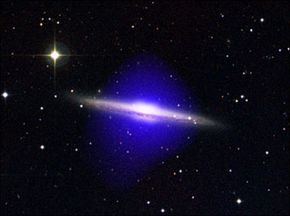
When you look at a normal galaxy, most of the light comes from the stars in visible wavelengths and is evenly distributed throughout the galaxy. However, if you observe some galaxies, you'll see intense light coming from their nuclei. And if you look at these same galaxies in the X-ray, ultraviolet, infrared and radio wavelengths, they appear to be giving off enormous amounts of energy, apparently from the nucleus. These are active galaxies, which represent a very small percentage of all galaxies. There are four classifications of active galaxy, but the type we observe may depend more upon our viewing angle than structural differences.
To explain active galaxies, scientists must be able to explain how they emit such large amounts of energy from such small areas of the galactic nuclei. The most accepted hypothesis is that at the center of each of these galaxies is a massive or supermassive black hole. Around the black hole is an accretion disk of rapidly spinning gas that's surrounded by a torus (a donut-shaped disk of gas and dust). As the material from the accretion disk falls into the area around the black hole (the event horizon), it heats to millions of degrees Kelvin and is accelerated outward in the jets.
Discovered by Carl Seyfert in 1943, these galaxies (2 percent of all spiral galaxies) have broad spectra indicating cores of hot, low-density ionized gas. The nuclei of these galaxies change brightness every few weeks, so we know that the objects in the center must be relatively small (about the size of a solar system). Using Doppler shifts, astronomers have noticed that velocities at the center of Seyfert galaxies are about 30 times greater than those of normal galaxies.
Radio galaxies are elliptical (0.01 percent of all galaxies are radio galaxies). Their nuclei emit jets of high-velocity gas (near the speed of light) above and below the galaxy -- the jets interact with magnetic fields and emit radio signals.
Quasars (quasi-stellar objects)
Quasars were discovered in the early 1960s. About 13,000 have been discovered, but there could be as many as 100,000 out there [source: A Review of the Universe]. They're billions of light years away from the Milky Way and are the most energetic objects in the universe. The extreme brightness of quasars can fluctuate over daylong periods, which indicates that the energy is coming from a very small area. Thousands of quasars have been found, and they're believed to be emanating from the cores of distant galaxies.
Blazars are a type of active galaxy -- about 1,000 have been cataloged [source: A Review of the Universe]. From our viewpoint, we are looking "head-on" at the jet emanating from the galaxy. Like quasars, their brightness can fluctuate rapidly -- sometimes in less than one day.
Take a look at the links on the next page for more information about galaxies.
Starburst GalaxiesMost galaxies have low rates of new star formation -- about one a year. However, starburst galaxiesproduce more than 100 a year. At this pace, starburst galaxies use up all of their gas and dust in about 100 million years, which is short compared to the billions of years that most galaxies have been around. Starburst galaxies emit their intense light from a small area of newly formed stars and supernovae. So, astronomers think that starburst galaxies represent some short phase in how galaxies change and evolve, perhaps a stage prior to becoming an active galaxy.
Originally Published: Feb 7, 2008