The space probe Pioneer 10 was launched on March 3, 1972. After a journey through our solar system, it entered deep space, on a trajectory that will take it to Aldebaran, a star located in the constellation Taurus. What will Pioneer 10 encounter as it makes its two-million-year journey across interstellar space? Nothingness? A void? Complete blackness?
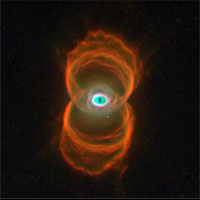
In reality, the great emptiness that exists between the Sun and Aldebaran is not empty at all. It's filled with dust and gases, what astronomers call interstellar matter. Sometimes, this interstellar matter is collected in such a way that it's visible to Earth-bound observers, either as a glowing cloud or as a dark silhouette against a lighter background. These clouds are nebulae. A single such cloud is a nebula, which is Latin for "mist" or "cloud."
Until the 20th century, astronomers used the term nebula to describe any glowing, cloud-like object observed from Earth. The telescopes of the day revealed very little detail about these objects, but astronomers could see enough to know that these nebulae came in different shapes. Some were called spiral nebulae; others were called elliptical nebulae. Then, in the 1920s, American astronomer Edwin Powell Hubble, using the most powerful telescope of his day, discovered that many of the objects believed to be vague, indistinct clouds were in fact galaxies. Specifically, he observed that the Andromeda spiral nebula was actually a spiral galaxy.
Today, astronomers know that galaxies and nebulae are unique objects with different characteristics. Yet this distinction alone is not enough to fully explain what nebulae are and how they work. This article will go beyond the fundamental definition to provide a more thorough overview of nebulae -- what they're, what they're made of, where they're located and what they do. Our first step is to understand a nebula's place in the grand design of the universe.
To understand the place of nebulae in the universe, it's helpful to think like an astronomer. Astronomers make sense of the universe by organizing it into a series of "nested" levels. Nebulae, which are enormous objects in their own right, occupy a level in the middle of this hierarchy. This is the sequence: Superclusters form the top level, followed by clusters, galaxies, nebulae, star systems, stars, planets and moons. Let's look briefly at each, using the illustration below as a guide.
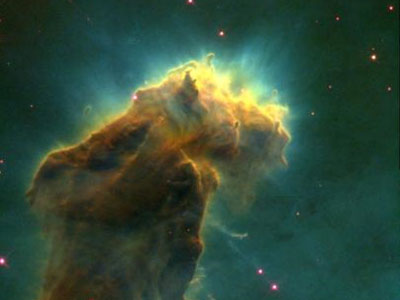
Finally, at a level of the cosmic hierarchy that is difficult to show on our scale, we have planets and moons -- mere specks compared to nebulae. Asteroids, comets and meteoroids are even smaller, ranging in size from small moons to large rocks.
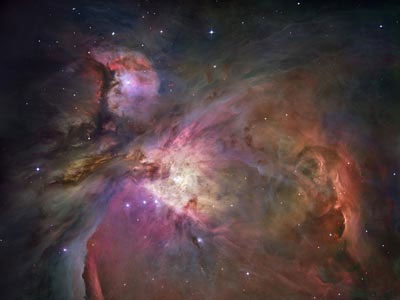
Now that we have a scale to work with, let's examine the different type of nebulae in greater detail. Astronomers generally classify nebulae into two broad categories -- bright and dark. Bright nebulae are close enough to nearby stars that they glow, although the method in which they produce that glow depends on two factors. The first is a nebula's proximity to the star, and the second is the star's temperature. When a nebula is very close to a hot star, it can absorb large amounts of ultraviolet radiation. This heats the gas to about 10,000 Kelvin (9,726 degrees Celsius or 17,540 degrees Fahrenheit). At such extreme temperatures, the hydrogen gas becomes excited and glows with a fluorescent light. Astronomers refer to this type of nebula as an emission nebula. The Great Nebula in Orion (M42) is a classic emission nebula.
Sometimes, a nebula is farther away from a star or the star is not as hot. In this case, the dust of the nebular cloud reflects the light, much like tarnished silver reflecting candlelight. Most reflection nebulae take on a bluish color because the particles preferentially scatter blue light. A few, however, strongly reflect the light of the star that illuminates them. The Pleiades star cluster in Taurus contains several reflective nebulae.
Dark nebulae are not close enough to stars to be illuminated. They're visible only when something
brighter -- a star cluster, for example -- provides a backdrop. Sometimes, dark nebulae appear as lanes, alleys or globules within bright nebulae. The Trifid Nebula is a brilliant red emission nebula that appears to be divided into three regions by dark dust alleys. The Horsehead Nebula in Orion is also a dark nebula, as is the large dark band that divides the Milky Way in two along its length.
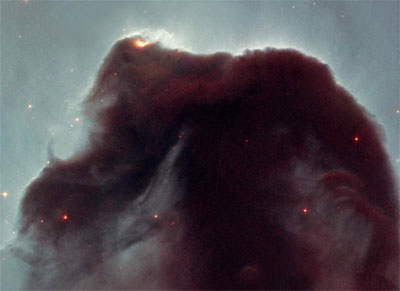
In addition to being classified either bright or dark, nebulae also receive names. Charles Messier, a French astronomer, began to catalog non-star objects in the 18th century. Instead of using names, he used numbers. The first object he listed was the Crab Nebula in Taurus, which he designated Messier-1, or M-1. He designated the Ring Nebula M-57. Galaxies also made his list. The Andromeda Galaxy, the 31st object he recorded, became M-31. In the 19th century, amateur astronomers gave common names to almost all of the Messier objects, based on what they look like. That's how names such as the Dumbbell Nebula, the Horsehead Nebula and the Owl Nebula entered the astronomical lexicon. Some nebulae, such as the Orion Nebula, got named after the constellation that they appear to be part of.
Few names, however, hint at the vital role nebulae play in the cosmos. On the next page, we'll learn that nebulae do more than glow prettily in the night sky.
The classification scheme described above, while helpful, seems to imply that a nebula is constant and unchanging, existing in one state forever. This is not the case. The various bright and dark nebulae actually represent different stages in stellar evolution. Let's examine this evolutionary process to understand how nebulae act as a cradle of star formation.
Dark Nebulae: Seeds Are Planted
We already know that nebulae are low-density clouds. We also know, intuitively, that stars are very dense objects. If a nebula is to act as a birthplace to stars, then its building-block materials -- dust particles and hydrogen and helium gas -- must be pulled together and compressed into a relatively small "ball" of matter. As it turns out, this condensation process occurs in various regions throughout dark nebulae (reflection nebulae, as well, which are really nothing more than dark nebulae that reflect the light of nearby stars).
Gravity is the force that drives condensation. As a ball of dust and gas contracts under its own gravity, it begins to shrink and its core begins collapsing faster and faster. This causes the core to heat up and to rotate. At this stage, the condensed material is called a protostar. One nebula may have many protostars, each of which is destined to be an individual stellar system.
Some protostars have less mass than our sun. They're so small that they can't initiate the thermonuclear reactions so typical of stars. Even still, these objects may glow dimly because the force of gravity causes them to continue shrinking, which releases energy in the process. Astronomers label these objects brown dwarves as a way to describe their small size and relatively insignificant power output.
Other protostars are bigger, many times more massive than our own sun. These large protostars continue to contract, but instead of producing heat through contraction alone, they begin to convert hydrogen into helium in a process known as thermonuclear fusion. At this point, the protostar phase is over and a true star begins to form. Around it's a whirling cloud of residual dust and gas -- the very material that can build, over billions of years, a system of planets and moons.
Emission Nebulae: A Star Is Born
When a protostar becomes a self-radiating object, fueled by its own thermonuclear reactions, it becomes a true star. If it's massive enough, a star can ionize the nebular material, producing an area of fluorescence around it. The dark nebula, now glowing, becomes an emission nebula.
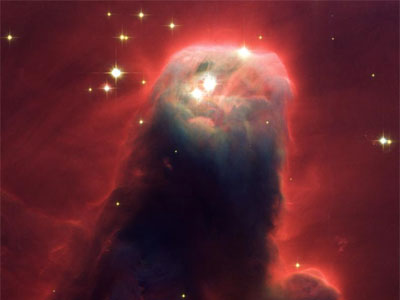
A single emission nebula can be filled with numerous newborn stars. A good example is the Cone Nebula, in Monoceros the Unicorn, an area of active star formation. The Cone Nebula is part of an enormous cloud of hydrogen gas that cradles many brand-new stars, which vary drastically in brightness because many are still cloaked in cloud and dust. The brightest star associated with the Cone Nebula is S Monocerotos.
Nebulae may also mark the site of a star's demise. On the next page, we'll look at how that can happen.
There are two types of bright nebulae that are associated, not with star birth, but with star death. The first of these are planetary nebulae, so called because they're round objects that resemble planets. A planetary nebula is the detached outer atmosphere of a red giant star, which is one of the final stages in a medium-sized star's lifecycle. This is how planetary nebulae come to be:
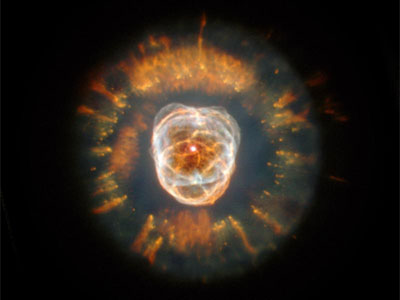
A good example of a planetary nebula is the Eskimo Nebula, which is located about 5,000 light-years from Earth in the constellation Gemini. Discovered by William Herschel in 1787, the nebula gets its name because, when viewed through ground-based telescopes, it resembles a face surrounded by a fur parka. The parka is actually a ring of material streaming away from a central, dying star.
If a star is massive enough, it doesn't die as a red giant, but as a supernova. A supernova occurs when a star explodes and throws off most of its material into space. When a supernova involves a binary, or two-star system, it's known as a Type 1 supernova. When a supernova involves a lone star, it's known as a Type 2 supernova.
In Type 1 supernovas, one star in the binary system is a white dwarf, a dying star that has consumed almost all of its hydrogen. The white dwarf pulls material from the outer layers of its companion star. This material burns in the dwarf's outer regions, causing its core to heat up to extreme temperatures. As the white dwarf is consumed in a runaway reaction, it explodes, expelling its remains in a vast cloud -- a nebula. On average, a Type 1 supernova occurs in a galaxy once every 140 years [source: Ronan].
Type 2 supernovas occur more frequently, perhaps once every 91 years in a galaxy [source: Ronan]. In a Type 2 supernova, a single star experiences a sudden collapse. The core of such a star becomes massively dense -- a tightly packed ball of neutrons. As the rest of the star's material falls inward under its own weight, it hits the core with such force that it "bounces" back outward again in a magnificent explosion. This explosion forms a visible nebula that can be observed easily from Earth.
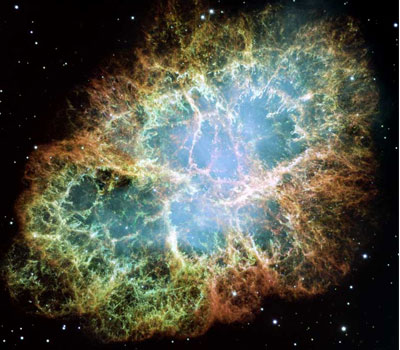
The best-studied Type 2 supernova is the Crab Nebula, discovered in A.D. 1054 by Chinese and Arab astronomers, who believed they were looking at a new star. The "star" became brighter during several weeks and, by July, could be observed for 23 days even in the daytime. It remained visible to the naked eye for about two years. The supernova SN1987A, in the Large Magellanic Cloud, is another Type 2 supernova that exploded in 1987. Its nebula expanded to the diameter of Earth's orbit around the Sun -- 300 million kilometers -- in just 10 hours [source: Ronan].
You might think that such discoveries are rare, but as we'll see in the next section, astronomers continue to find new nebulae and find out new things about nebulae that have been studied for years.
Scientists continue to expand their understanding of even long-studied nebulae. Most of these advances are due to improvements in telescopes and other observational technology. The Hubble Telescope has revealed a great detail about nebulae. In 2005, the space telescope captured the most detailed view of the Crab Nebula in one of the largest images ever assembled by the observatory. And in 2006, the Spitzer Telescope (launched in 2003 as the Space Infrared Telescope) collected never-before-seen data about the Orion Nebula.
Spitzer's infrared eye found some 2,300 disks of planet-forming material that were either too small or distant to be seen by most traditional telescopes scanning Orion in the visible range of the electromagnetic spectrum. Spitzer also revealed about 200 "baby" stars that had yet to develop any planetary disks [source: NASA Jet Propulsion Laboratory].
These are the wonders that space probes such as Pioneer 10 may encounter as they journey across the galaxy. Space explorers, however, may never enjoy a firsthand glimpse of nebulae. Orion, the nearest stellar factory to our home planet, sits about 1,450 light-years from Earth.
For more about nebulae, astronomy and related topics, take a look at the links on the next page.
Originally Published: Jun 18, 2008
Related HowStuffWorks articles
More Great Links
Sources