On March 11, 2003, the United States Air Force tested one of the largest conventional bombs ever built. It is called the MOAB -- Massive Ordnance Air Burst. It is a bomb designed to destroy heavily reinforced targets or to shatter ground forces and armor across a large area.
In this article, we'll examine this new high-powered bomb and see where it fits into the U.S. arsenal.
ContentsHere are the basic facts about the MOAB:
The idea behind an "air burst" weapon, as opposed to a weapon that explodes on impact with the ground, is to increase its destructive range. A bomb that penetrates the ground and then bursts tends to send all of its energy either down into the ground or straight up into the air. An air burst weapon sends a great deal of its energy out to the side.
The MOAB will replace the BLU-82, also known as the Daisy Cutter, a 15,000-pound (6,800-kg) air-burst bomb developed during the Vietnam war. The Air Force could drop a Daisy Cutter to create an instant helicopter landing site. The explosive force would clear out trees in a 500-foot-diameter (152-meter) circle.
The MOAB is not the largest bomb ever created. In the 1950s the United States manufactured the T-12, a 43,600-pound (19,800-kg) bomb that could be dropped from the B-36.
Compared to a nuclear bomb, the MOAB produces a tiny explosion. The smallest known nuclear bomb -- the Davy Crockett fission bomb -- has a 10-ton yield. The difference is that a nuclear bomb that small weighs less than 100 pounds (45 kg) and produces significant amounts of lethal radiation when it detonates. For comparison, the nuclear bomb dropped on Hiroshima had a yield of 14,500 tons of TNT and weighed only 10,000 pounds (4,500 kg) -- half the weight of the MOAB. See How Nuclear Bombs Work for details.
MOAB DeploymentYou can see a U.S. Department of Defense video of the MOAB being deployed on April 13, 2017, in eastern Afghanistan here. The U.S. military explained that the intent of the strike was to "minimize the risk to Afghan and U.S. forces conducting clearing operations in the area while maximizing the destruction of ISIS-K fighters and facilities."
 C-130 Hercules Aircraft
Photo courtesy U.S. Air Force
C-130 Hercules Aircraft
Photo courtesy U.S. Air ForceInstead of being dropped from a bomber through the bomb bay doors, the MOAB is pushed out of the back of a cargo plane such as a C-130. The bomb rides on a pallet. A parachute pulls the pallet and bomb out of the plane and then the pallet separates so that the bomb can fall.
In one Department of Defense video, you could see the pallet and bomb come out of the back of the plane and then separate from one another within a few seconds. The bomb then accelerates rapidly to its terminal velocity.
Once the bomb is falling, a guidance system based on the Global Positioning System takes over and directs the bomb to its target.
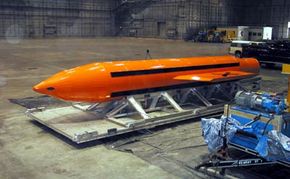
 Air Force workers prepare the MOAB for testing. A GPS receiver uses the flaps shown here to change the direction of the bomb as it falls. Smart bombs like this can hit their targets very accurately.
Photo courtesy U.S. Department of Defense
Air Force workers prepare the MOAB for testing. A GPS receiver uses the flaps shown here to change the direction of the bomb as it falls. Smart bombs like this can hit their targets very accurately.
Photo courtesy U.S. Department of DefenseThe MOAB is built by Dynetics and contains approximately 18,000 pounds of tritonal. Tritonal is a mixture of TNT (80%) and aluminum powder (20%). The aluminum improves the brisance of the TNT -- the speed at which the explosive develops its maximum pressure. The addition of aluminum makes tritonal about 18% more powerful than TNT alone.
A Daisy Cutter, by comparison, contains 12,600 pounds (5,700 kg) of ammonium nitrate, aluminum and polystyrene, a combination known as GSX (gelled slurry explosives). GSX is commonly used in mining and is a commercial high explosive that is inexpensive and easy to produce. TNT is a military high explosive.
 Front and rear view of a BLU-82 free-fall bomb (Daisy Cutter)
Photo courtesy U.S. Department of Defense
Front and rear view of a BLU-82 free-fall bomb (Daisy Cutter)
Photo courtesy U.S. Department of DefenseFor more information on MOAB and related topics, check out the links on the next page.