Understanding Carrier Battle Groups: How They Operate
If you've read the HowStuffWorks article How Aircraft Carriers Work, then you know about many of the amazing features of aircraft carriers:
They are 20 stories high and over 1,000 feet (305 m) long.
They are powered by nuclear reactors rather than diesel engines or turbines.
They house 6,000 crew members and 70 to 80 aircraft.
They are constructed of about 1 billion individual pieces.
What this means is that an aircraft carrier is worth between $4 billion and $5 billion -- it is a substantial investment by itself. Plus, it is carrying a small town's worth of people as well as a billion dollars in aircraft.
Carrier Battle Group Image Gallery
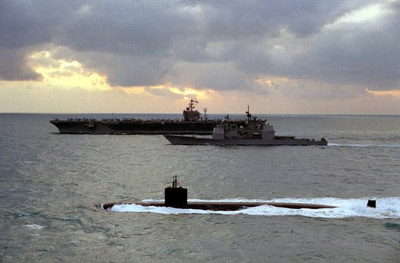
Photo courtesy Department of Defense - Defense Visual Information Center Nimitz battle group -- USS Nimitz aircraft carrier, guided-missile cruiser USS Port Royal, and nuclear-powered submarine USS Annapolis -- in the North Persian Gulf during Operation Southern Watch. See Carrier Battle Groups in action.
In other words, an aircraft carrier is extremely valuable. And without protection, an aircraft carrier is extremely vulnerable. That's why aircraft carriers never leave home alone. They are always escorted by an extensive flotilla of other ships. The aircraft carrier plus the flotilla is known as the carrier battle group. A modern carrier battle group is nearly invincible.
In this article, you will learn about these powerful collections of military force and see why they have become so important to U.S. naval operations.
Contents
The Carrier
The Carrier Battle Group
The Carrier Battle Group in Action
The Carrier
An aircraft carrier allows the U.S. navy to move an entire airport, along with 70 to 80 fighters, bombers and support aircraft, anywhere in the world where there is an ocean. This ability gives the United States incredible flexibility, because there is no need for treaties or permission from other nations. With a speed of approximately 700 nautical miles per day and bases on both the east coast of the United States and in Hawaii, aircraft carriers can arrive anywhere in the world in less than two weeks.
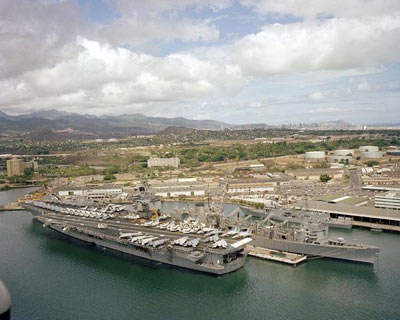
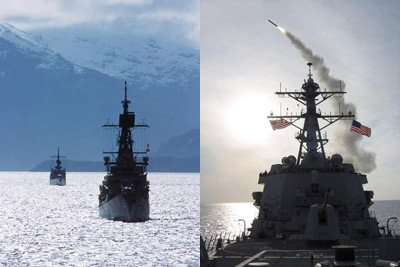
Photo courtesy Department of Defense - Defense Visual Information Center Left: Nuclear-powered aircraft carrier USS Enterprise Right: USS Sacramento support ship, USS Reid frigate
Because aircraft carriers are so valuable, because they are so powerful and because they are so few in number (the U.S. has only 12 of them, with two under construction [ref]), they are very obvious targets for enemy forces. Aircraft carriers are also huge and impossible to hide. They are vulnerable from several different angles:
The enemy can attack from the sea with boats equipped with long-range cannons and cruise missiles.
The enemy can attack from underwater with submarines, mines and torpedoes.
The enemy can attack from the air with airplanes, bombs and missiles.
The carrier battle group is responsible, therefore, for protecting the aircraft carrier at the center of the group.
The Carrier Battle Group
The U.S. Navy forms carrier battle groups on an as-needed basis and assigns ships to the group based on the mission. Therefore, no two carrier battle groups are the same. However, a typical carrier battle group consists of the following ships:
The aircraft carrier itself
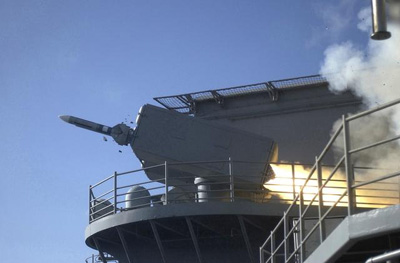
Photo courtesy Department of Defense - Defense Visual Information Center Aircraft carrier USS Kitty Hawk launching a radar-guided, air-to-air missile during a live-fire exercise
Two guided-missile cruisers
These are offensive ships loaded with cruise missiles to strike land targets
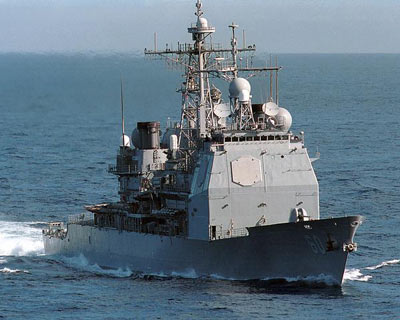
Photo courtesy Department of Defense - Defense Visual Information Center Guided-missile cruiser USS Normandy
Two destroyers
Destroyers traditionally are defensive ships. They can defend against attacks by submarines and aircraft (Nav Facts: Destroyers/a> provides a very nice description of the evolution of destroyers). Destroyers now also come equipped with the ability to launch cruise missiles.
Photo courtesy Department of Defense - Defense Visual Information Center Guided-missile destroyer USS Winton S. Churchill launching a Tomahawk Missile during Operation Iraqi Freedom
One frigate
The frigate is used for anti-submarine defense.
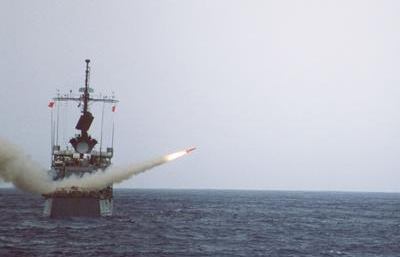
Photo courtesy Department of Defense - Defense Visual Information Center Guided-missile frigate USS Talbot launching a target drone during a training exercise off the coast of Chile
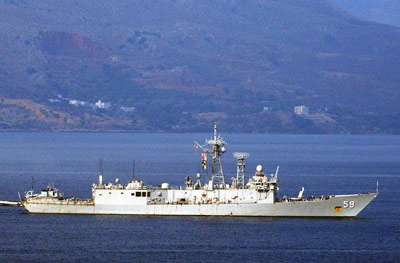
Photo courtesy Department of Defense - Defense Visual Information Center Guided-missile frigate USS Kauffman in Souda Bay, Crete, Greece, during Operation Enduring Freedom
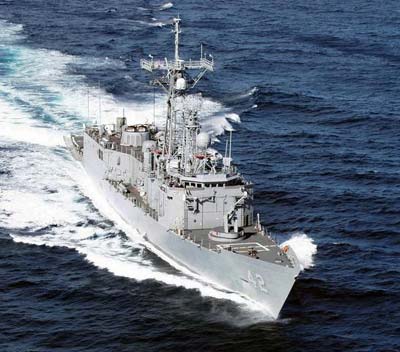
Photo courtesy Department of Defense - Defense Visual Information Center Guided-missile frigate USS Klakring on its way to the Pacific Phase of Exercise Unitas 43-02 (click here for information about Exercise Unitas)
Two submarines
The submarines are defensive ships that can attack enemy ships and submarines.
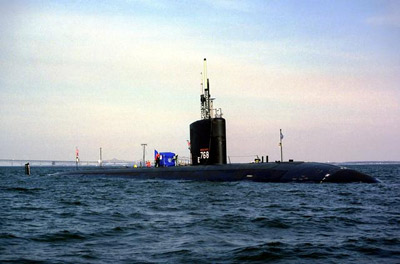
Photo courtesy Department of Defense - Defense Visual Information Center Nuclear-powered submarine USS Hartford
A supply ship
The supply ship carries fuel, food and ammunition for the group.
There may be other ships that travel with the group. For example, there may be troop ships, amphibious ships for the marines, cargo ships carrying tanks and other equipment, mine sweepers, etc. It all depends on the mission.
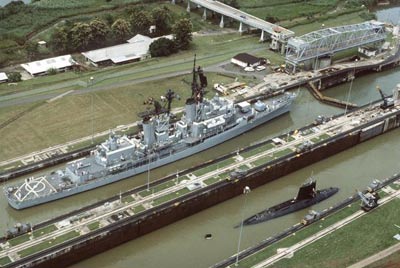
Photo courtesy Department of Defense - Defense Visual Information Center Aerial view of guided-missile destroyer USS MacDonough and nuclear-powered submarine USS Scamp traveling through the Panama Canal during a training exercise
The Carrier Battle Group in Action
When a carrier battle group arrives at its destination, the 10 or so ships deploy and begin operations. There are approximately 80 aircraft available, and perhaps 8,000 men and women at work. There are two goals:
Accomplish the assigned mission
Defend the battle group against any type of enemy attack
The defensive role is an around-the-clock operation. Carrier battle groups must be constantly vigilant against attack from the air, from the sea and from underwater.
To accomplish its mission, a carrier air wing typically consists of nine squadrons, with 70 to 80 total aircraft. The more notable aircraft include:
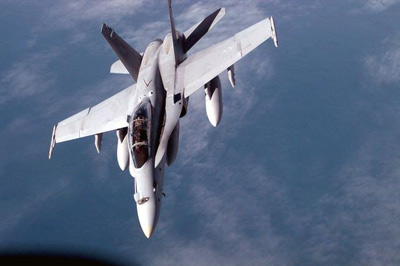
The F/A-18 Hornet - A single-seat strike fighter jet designed to take out enemy aircraft as well as ground targets
Photo courtesy Department of Defense - Defense Visual Information Center F/A-18 Hornet
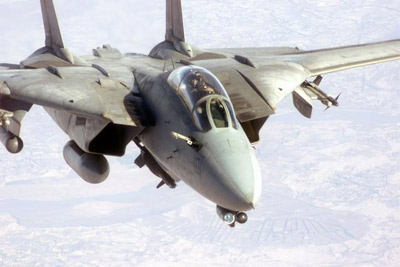
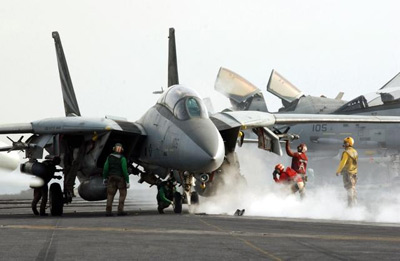
The F-14 Tomcat - A two-seat fighter jet optimized for air superiority (A carrier's F-14 squadron is a crucial weapon in protecting the carrier battle group.)
Photo courtesy Department of Defense - Defense Visual Information Center F-14 Tomcat preparing to refuel
Photo courtesy Department of Defense - Defense Visual Information Center Flight deck personnel aboard the USS Kitty Hawk aircraft carrier preparing to launch an F-14 Tomcat
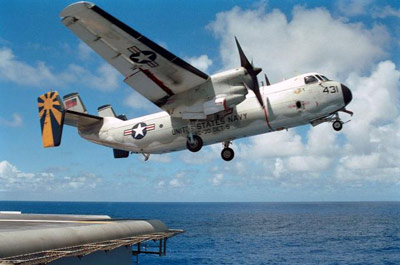
The E-2C Hawkeye - A tactical warning and control system aircraft (The aircraft's advanced radar system lets the air wing keep the fighter jets updated on enemy activity.)
Photo courtesy Department of Defense - Defense Visual Information Center C-2 Greyhound launching from the USS Kitty Hawk
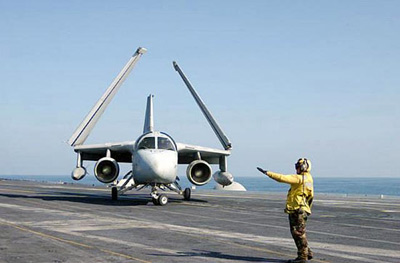
The S-3B Viking - A subsonic jet aircraft primarily used to take out enemy submarines
Photo courtesy Department of Defense - Defense Visual Information Center S-3B Viking parking aboard the USS Kitty Hawk
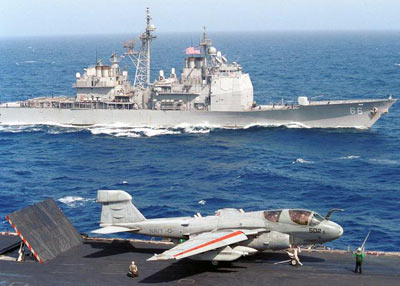
The EA-6B Prowler - An electronic warfare aircraft (The Prowler's mission is to jam enemy radar and intercept enemy communications.)
Photo courtesy Department of Defense - Defense Visual Information Center EA-6B Prowler aboard the aircraft carrier USS John F. Kennedy
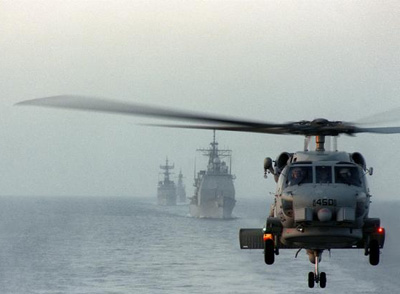
The SH-60 Seahawk - A twin-engine helicopter primarily used to attack enemy submarines and in search-and-rescue operations
Photo courtesy Department of Defense - Defense Visual Information Center SH-60B Seahawk, in the USS Saratoga carrier battle group
To provide a defensive view of the area, the destroyers have powerful radar systems that look upward to search for incoming aircraft. The E-2C Hawkeye aircraft launched from the carrier fly overhead and use their radar to look downward, letting them see low-flying aircraft and ships that may be approaching from over the horizon. The destroyers and frigate use sonar and magnetic sensors to look for submarines approaching from underwater. The goal is to create a sealed bubble around the carrier, with nothing able to enter the bubble without approval.
To learn more about carrier battle groups, aircraft carriers and related topics, check out the links on the follow page.
Lots More Information
Related HowStuffWorks Articles
How Aircraft Carriers Work
How Cruise Missiles Work
How F-15s Work
How Submarines Work
How Radar Works
More Great Links
U.S. Naval Institute: The Carrier Battle Group
Vulture's Row: Carrier Battle Group Composition
MilitarySurfWax: News & Articles on Carrier Battle Group
CNN.com: Carrier group departs for Arabian Sea - November 12, 2001