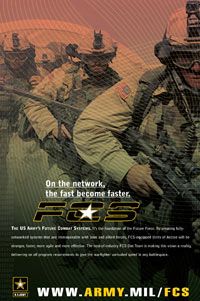
The Future Combat Systems (FCS) initiative is a massive overhaul of military technology intended to prepare the U.S. Army for modern warfare. Current projections suggest that it will be the most expensive military project in U.S. history and will take decades to design and complete. Creating the hardware, software, networks and integration necessary to make FCS work is an incredibly complicated project.
The Army wants to dominate the full-spectrum battlefield - land, sea and air. To accomplish this, it will need several different types of units. The Army must also link its operations with that of the other military branches, and the militaries of other nations that might join them in a coalition operation.
FCS is a "system of systems," because it actually comprises 18 separate systems. Each system is a type of unit, such as an unmanned artillery vehicle, a manned tank or a command and control vehicle. FCS is also sometimes called "18+1+1," where the "+1"s represent the network and the soldier who will utilize the systems. If the Army were simply revamping their military hardware and designing 18 new combat and logistics units, that would be a major project by itself. Designing all 18 from the ground up with the architecture to link every unit makes FCS truly revolutionary.
So why is the Army undertaking such a huge project? Military experts believe the nature of warfare is changing. Large-scale territory battles like those fought in World War II will disappear. Instead, the Army will probably face insurgencies and smaller conflicts spread out over wide areas. Tomorrow's Army needs the ability to deploy and redeploy as quickly as possible. To this end, the FCS has four main goals:
We'll see how the Army plans to deal with these issues next.
Contents
The network is the core of Future Combat Systems. It will allow each unit to share real-time information with other units, coordinate movement and react to battlefield conditions quickly and accurately. Network-centric warfare is a relatively new concept that unifies all of the advantages gained by other elements of FCS. For example, a tank platoon that can be deployed quickly and move with agility has no advantage if their orders are delayed or unclear, or if their commanders don't have enough information to make the right decision in the shortest amount of time. The network will allow for speed of command.
Network-centric warfare changes the way commanders look at their armies. Instead of a contest of numbers (my 3,000 troops can beat your 1,000 troops), the U.S. Army becomes one entity with many parts that can shift and adapt to quickly-developing situations. Information is shared across the entire network.
The network comprises several components. The Joint Tactical Radio System (JTRS, often referred to as "Jitters"), was designed to do away with the need for multiple bulky radio systems using various frequencies and encryption methods. It would allow all branches of the U.S. military to communicate with each other from land, sea and air using the same system. However, critics found the JTRS plan of replacing older analog radios (many of which aren't very old at all, having just been purchased for operations in the Middle East) overly ambitious and almost impossible to implement. Today, JTRS is still in development as a supplemental communications program that will act as a soldier's "gateway" to the overall FCS network [ref].
The System-of-Systems Common Operating Environment (SOSCOE) is software that will allow all of the various systems to operate seamlessly. It will take roughly 35 million lines of code to properly program SOSCOE [ref]. The operating system is a blend of Linux and an Intel-based OS specially created for the Army.
The WIN-T system is the data transport system that will connect the FCS systems. WIN-T will utilize lasers, satellites and more conventional ground networks. The WIN-T system is basically a tactical Internet, keeping fast-moving units in communication with operational leadership. Not only does WIN-T have to provide the massive amount of bandwidth to carry all of the information FCS will be generating, but it must also be strong enough to deal with the battlefield environment [ref].
The need for tactical agility has led the Army to focus design efforts on lighter, faster combat vehicles. Today's main battle tank, the M1 Abrams, weighs 65 to 70 tons, depending on its configuration. Its front armor is capable of stopping just about any anti-tank round in existence. However, next-generation ballistic weapons will strike with immense force. Instead of layering a tank with more armor, creating a heavier, slower vehicle, the Army has opted for a 20-ton design. These future tanks will use ultra-modern technologies (some of which don't actually exist yet) to resist anti-tank weapons.
New armor materials are one part of the plan, but the tanks will also have a small signature - its small size will make it tougher to find and hit. An active suspension system will allow the tank to "crouch" into a very low position. The Army will also employ active countermeasures like smoke screens to obscure line of sight and small rocket rounds that can intercept incoming rounds from enemies.
 The M1 tank weighs 65 to 70 tons and has front armor that can stop most anti-tank rounds. However, the Army hopes to create a much lighter, smaller tank that can evade enemies without the need for heavy armor.
Image courtesy U.S. Department of Defense
The M1 tank weighs 65 to 70 tons and has front armor that can stop most anti-tank rounds. However, the Army hopes to create a much lighter, smaller tank that can evade enemies without the need for heavy armor.
Image courtesy U.S. Department of DefenseAccording to a press release, "The Army transformation requirements includes the ability to put a combat-capable brigade anywhere in the world within 96 hours, a full division in 120 hours, and five divisions on the ground within 30 days" [ref]. One way to increase strategic agility is to allow fewer soldiers to do more work. This continues a trend that has gone on for centuries. At the Battle of Gettysburg, the Union line was a few miles long and covered by roughly six corps. The average tourist can walk the length of the line in one afternoon. During the Cold War, roughly the same number of NATO troops (and corps) covered the entire inter-German border - a distance that you certainly could not walk in an afternoon [ref].
FCS will allow for even greater dispersion of forces by utilizing unmanned vehicles, unmanned weapons platforms and robot sentries. Manned vehicles will require smaller crews - the FCS tank will have a crew of just two, compared to the M1's crew of four.
 The Warrior unmanned aerial vehicle prototype is diesel-powered, eliminating the need for special fuel on the battlefield.
Image courtesy U.S. Army
The Warrior unmanned aerial vehicle prototype is diesel-powered, eliminating the need for special fuel on the battlefield.
Image courtesy U.S. ArmyThe Army wants to reduce the amount of fuel needed by its units by as much as 30 percent. For example, the gas turbine engine that powers the M1 Abrams gives it enormous power and the ability to travel close to 45 mph, but it also uses an incredible amount of fuel. Vehicles and tanks developed for FCS will likely use some form of electric-hybrid engine, increasing both available torque and fuel efficiency.
In the next section we'll learn more about these vehicles and the other vehicles planned for FCS.
 The Swarmbot is a prototype UGS developed by iRobot in conjunction with DARPA. These autonomous robots can communicate with each other and function as a team.
Image courtesy iRobot Corporation
The Swarmbot is a prototype UGS developed by iRobot in conjunction with DARPA. These autonomous robots can communicate with each other and function as a team.
Image courtesy iRobot Corporation
The FCS project includes the design and development of several different types of air and ground vehicles, many of them unmanned and autonomous. Most of these vehicles don't exist yet, but some prototypes have been developed and demonstrated by contractors. A few are already in use in Iraq to dispose of explosive and perform urban reconnaissance.
Unattended Ground Sensors (UGS)
These small sensor arrays are similar to "Star Wars" droids, but they're not quite as mobile. After soldiers or robotic vehicles deploy them, they will be able to stay in place to do their jobs. Those jobs may include guarding areas of a perimeter, detecting chemical or radioactive materials, providing links in communications chains, spotting targets for other units to fire upon, and assisting in crowd control by directing people to head in a certain direction. They can also be switched on and off to allow friendly troops to move through the area.
Non-line of Sight Launch System (NLOS-LS)
These systems would come in discreet packages containing a computer, a communication system for connection to the network, and 15 missiles. Soldiers can give the missiles their launch instructions remotely, and can further modify targeting once they are in the air.
Intelligent Munitions System
Similar to Unattended Ground Sensors, these robotic units will be deployed to an area to guard it with suppressive weapons. This will aid in troop dispersion, help organize battlefields and force enemy troops into desired positions.
Unmanned Aerial Vehicles
The FCS plan also calls for four different classes of Unmanned Aerial Vehicles (UAVs):
 The Fire Scout Apache, an autonomous Class IV UAV developed by Northrop Grumman for the U.S. Army's FCS initiative.
Image courtesy Northrop Grumman Corporation
The Fire Scout Apache, an autonomous Class IV UAV developed by Northrop Grumman for the U.S. Army's FCS initiative.
Image courtesy Northrop Grumman CorporationArmed Robotic Vehicle (ARV)
One of the most revolutionary aspects of FCS is the adoption of these robotic tanks. These units will be controlled remotely and provide many of the functions of a manned tank unit. They will offer support for troops with direct fire, anti-tank fire and over-watch fire. ARVs will also increase troop dispersion.
Small Unmanned Ground Vehicle (SUGV)
These units are already in use in Iraq. Talon robots and Packbots have seen significant action in explosive disposal and urban reconnaissance missions, and future versions will have offensive capabilities.
 The "Talon" was employed on January 6, 2005, by the 184th EOD Robotics Team stationed in Baghdad, Iraq.
Photographer: Spc. Jonathan Montgomery Image courtesy U.S. Army
The "Talon" was employed on January 6, 2005, by the 184th EOD Robotics Team stationed in Baghdad, Iraq.
Photographer: Spc. Jonathan Montgomery Image courtesy U.S. ArmyMultifunctional Utility/Logistics and Equipment (MULE)
The MULE will be the workhorse of the FCS. This two-and-a-half ton truck will be able to operate via remote control or as a slave unit following a controlled vehicle in front of it. In addition to hauling equipment, the MULE will have a mine-sweeping configuration and an armed light assault configuration.
Crusher, an autonomous unmanned ground vehicle developed by Carnegie Mellon University, is essentially a prototype MULE. It can carry weapons and drive over a 4-foot vertical wall with 8,000 pounds of cargo onboard. To learn more, check out How Crusher Works.
Mounted Combat System (MCS)
The MCS is probably the most important piece of hardware in FCS, aside from the network. The MCS will replace the M1 Abrams main battle tank and will maintain a comparable survivability rate by using speed, situational awareness and an extremely long range 120-mm weapon to avoid close-up confrontations. Its 20-ton weight means that many MCS units will be able to ship via C-130 transport planes. They can also be parasailed into position if necessary.
To make the fleet more versatile while reducing operations and maintenance costs:
The Future Force Warrior
The individual soldier makes up the final element of FCS. Using the latest advances in personal body armor, an on-board computer and built-in networking, tomorrow's soldiers will have amazing situational awareness on any battlefield, and will be able to accomplish military tasks with greater efficiency. Check out How the Future Force Warrior Will Work to learn more.
We'll look at some potential problems with the FCS next.
 The U.S. Army's vision of how the FCS network will link different systems together.
Image courtesy U.S. Army
The U.S. Army's vision of how the FCS network will link different systems together.
Image courtesy U.S. ArmyThe Army is using spiral development to develop the FCS. Instead of working on the entire project from start to finish, with no deployable elements until everything is completed, contractors are developing systems incrementally. Finished subsystems will be immediately deployed for testing. Problems discovered with those units can be overcome as the Army adds more systems are added, and it can improve upon and upgrade early systems.
The Army keeps moving up the launch date for FCS because they want to get the technology into the field as soon as possible. It plans to deploy a test unit in 2008, with more systems releasing every two years until 2014. By that time, there will be 32 FCS-equipped brigades. The Army hopes to have the ability to equip any brigade with a fully-functional FCS system in 2016. It will take years beyond that point to fully equip the entire Army.
Like any complex design project, FCS is not entirely without problems. Critics point to several factors:
FCS is so ambitious that in some cases, the technology does not yet exist to accomplish it. The revision – some would say failure – of the JTRS system is one example of a system that has exceeded our current ability to actually make it work. Advanced ballistic armor, robotic control systems, automated sensors and high-bandwidth networks are all potential problem areas. It is likely that some FCS systems will never be fully functional and that current units and technologies will be retrofitted and upgraded to fit into the plan.
For lots more information about Future Combat Systems, the military and related topics, check out the links on the next page.
Sources