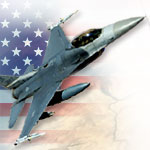
The U.S. Air Force is the youngest American military branch, forming in the 20th century after the invention of the airplane. Tasked with protecting the nation’s skies and supporting ground troops, the Air Force relies on the most technologically advanced military aircraft in the world. Operating those planes are highly trained pilots backed by technically skilled support crews.
The U.S. Air Force is the air combat branch of the U.S. military. In general terms, the Air Force's job is to prepare and train, and when needed, fight the aerial aspects of any military conflict the U.S. becomes involved in. The Air Force vision statement is: "Global Vigilance, Reach, and Power." Their mission statement, updated in 2005, is to "deliver sovereign options for the defense of the United States of America and its global interests -- to fly and fight in Air, Space, and Cyberspace."
The Thunderbirds
The
Thunderbirds are the Air Force's 3600th Air Demonstration Unit, a
special unit that does aerobatic displays at air shows and special
events to promote the U.S. Air Force, aid enlistment, and create a
positive public image of the military. Descended from the Sabre Dancers
demonstration team, the Thunderbirds were formed in 1953 at Luke Air
Force Base, in Litchfield Park, Ariz. Taking their name from a Native
American legend common to the area, the team gives dozens of
performances every year. In 2007, they provided a fly-over of Dolphin
Stadium at the beginning of Super Bowl XLI.
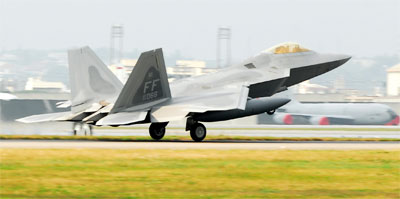
Specifically, the Air Force provides tactical support to ground troops with close air support missions and tactical bombing (flying into combat and eliminating specific enemy units). The Air Force also works to secure air superiority in a given theater -- the geographic area in which battle takes place -- by eliminating aerial threats, such as another nation's fighter planes or bombers. Much of the Air Force's role, however, is strategic. Their efforts are integral in the long-term success of a military campaign. Air Force planes conduct reconnaissance missions, transport troops and supplies, and conduct strategic bombing. Strategic bombing is destroying the enemy’s ability to wage war by attacking factories, supply lines, communications stations and other infrastructure.
Related Quiz
In this article, we'll look at the history of the Air Force, how it's structured, the process of joining and leaving, and life during time served.
During World War I, the Aeronautical Division was separated from the Signal Corps and became the U.S. Army Air Service. Because U.S. aircraft manufacturers were behind their European counterparts in the design and production of military planes, most U.S. pilots at the time flew British and French planes, some of which were manufactured in the U.S. under license. Peak wartime strength for the Air Service was 7,889 planes [Source: Yenne]. While the size of the Air Service dropped drastically in the interwar period, military air tactics, strategy and design were modernized. Production was ramped up again in 1939 as conflict was rekindled in Europe. The Air Service was given greater autonomy (while remaining a part of the U.S. Army) in 1941, when it was restructured into the U.S. Army Air Forces. The Air Force played an enormous role in WWII -- its exploits were crucial to Allied victory in every theater of the war. In 1944, Army Forces reached a historic peak unit strength of 78,757 aircraft with 2,372, 292 men [Source: Yenne].
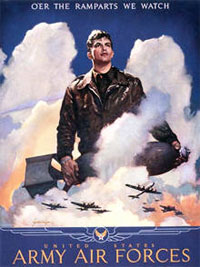
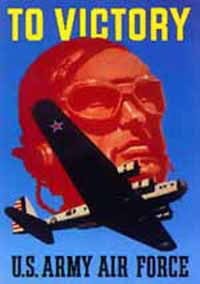
An overall reorganization of the U.S. military in 1947 lead to the creation of the U.S. Air Force, finally making it an independent and equal branch of the military within the Department of Defense.
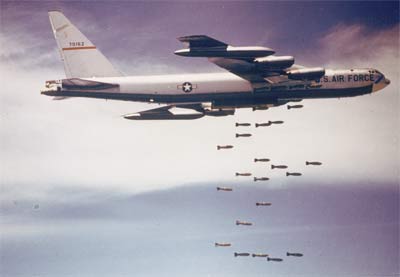
Throughout the Cold War, the Air Force was a vital part of the United States’ nuclear arsenal. While the Navy was in charge of submarine-based nuclear weapons, the Air Force’s Strategic Air Command (SAC) had control of both ground-launched Intercontinental Ballistic Missiles (ICBMs) and nuclear bombs carried on long-range bombers like the B-52 Stratofortress.
The Air Force's area of responsibility was extended into space in 1982, when the Air Force Space Command (AFSPC) was created. For the most part, AFSPC launches, operates and protects satellites for military use, including weather, communications and GPS satellites. In the future, AFSPC may utilize combat craft capable of entering space – for now, NASA's space shuttle is occasionally used to launch military payloads.
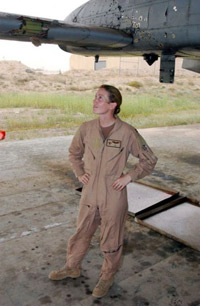
As of 2006, the Air Force has about 6,000 aircraft, with about 350,000 active personnel and another 250,000 in the Air National Guard and Reserve [source: 2006 USAF Almanac]. In 2003, there were just over 100 female fighter pilots in the Air Force; about two percent of the force's total fighter pilots.
One notable example is Major Kim Campbell, pilot of an A-10 Thunderbolt II under the Air Force call sign "Killer Chick." During a 2003 close air support mission over Baghdad, her plane suffered damage from a ground-based attack. Despite the loss of both redundant hydraulic control systems and damage to one engine, Campbell flew for one hour, returning to her base and landing safely using only mechanical control systems [source: Warbird Forum].
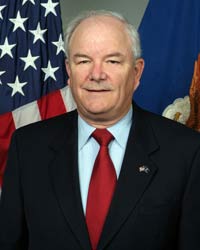
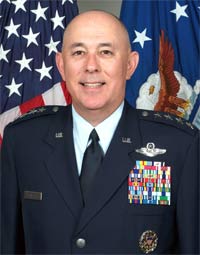
The Air Force is divided into major commands. Within the United States, the commands are divided by function. Outside the U.S., they are divided by geographic area.
The Major Commands are divided into 17 Numbered Air Forces (NAFs). The specific roles of the NAFs are subject to frequent reorganization. Within the NAFs are wings, each with 1,000 to 5,000 personnel. A wing may be an operational wing, an air-base wing or a specialized mission wing. An operational wing is often independent with all the support functions necessary to operate. Air base wings are assigned to specific air force bases and conduct the operations of the base.
There can be three to 10 squadrons within a wing. A squadron supports up 24 aircraft and their operational crews, although non-air units are also referred to as squadrons. Squadrons can also be further divided into flights, with up to 100 personnel. There are two types of flights: numbered flights and alphabetic flights. Numbered flights are units with unique numbered missions, such as training (in fact, they are typically used only in training). An alphabetic flight is a small component of a squadron.
During conflicts, the Air Force may divide their forces into Groups or Expeditionary Task Forces. The breakdown of Air Force units is more flexible (and more chaotic) than other military branches in part due to the Air Force’s high mobility, as well as the need to thoroughly integrate their efforts with those of the other armed forces.
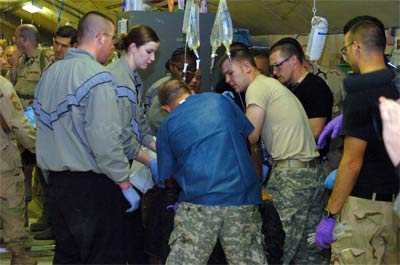
All enlisted personnel go through a six-week basic training program at Lackland Air Force Base in San Antonio, Texas. Like all military basic training programs, this one teaches the enlistees the military's way of doing things, puts them through grueling physical challenges and gives them the core skills they will need to function in the Air Force. From basic training, Airmen move on to Tech Training, conducted at several Air Force Bases around the United States. The Tech Training programs start the Airmen down their career path, teaching them the technical skills necessary to work in medical services, air traffic control, aircraft repair, computers and networking, or many other possible career tracks. It is possible to receive additional technical training later in one’s Air Force career.
Those who want to join the Air Force as an officer (and possibly some day fly a fighter jet) have several choices. Officer Training School (OTS) is a longer, tougher version of basic training -- graduates are commissioned at the rank of Second Lieutenant. Enlisted personnel may be eligible for OTS. The Air Force Reserve Officer Training Corps (ROTC) program gives potential officers the chance to train while attending college, receiving their commission when they graduate. The Air Force Academy is the most prestigious avenue to becoming an Air Force officer. Application requires a Congressional nomination. Cadets endure four years of extremely rigorous physical and academic training before graduating and becoming commissioned officers.
Back to the question of becoming a pilot -- all officers attend a technical training school, just like enlisted personnel. Officers who want to become pilots will put in a request to attend pilot training. However, a lot of people want to be pilots, and not everyone gets that opportunity. Competition is fierce, and only the top candidates will ever make it through flight school.
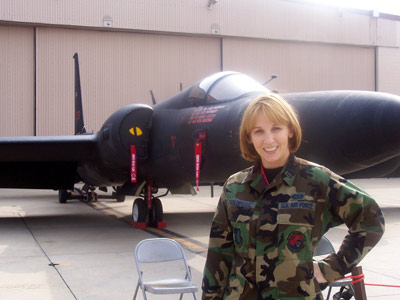
A typical day starts very early, at 0400 hours, or 4:00 a.m. That gives Goldfuss enough time to get into uniform, polish her boots and make sure her hair meets military regulations before arriving to work at 0530. As a weather officer, she is then briefed on the previous 12 hours of weather throughout the theater that Osan Air Force Base is responsible for: the Korean Peninsula, Japan, Hawaii, Guam and parts of China. From there, she goes to a Top Secret briefing room, where she gives a report to the general in charge of the base. Goldfuss explains that the weather itself isn't top secret, but a high security clearance is required "because of how it impacts the aircraft we fly."
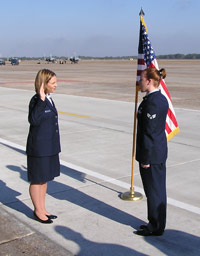
Reflecting the Air Force's focus on continuing education, Goldfuss spends a lot of time taking online military education courses and learning German (she knows her next assignment will take her to an Air Force Base in Germany). Base personnel also take part in combat exercises. "We pretend we're at war, so we practice as if bombs are dropping, guns are firing, all hell is breaking loose. My job during these times is to give weather for specific locations, help out with Personnel Recovery missions, and keep people informed of weather all over the theater."
Life on an Air Force Base gives Air Force officers and enlisted troops a variety of ways to spend their free time. Everything they need is on the base itself, so just about anything is within walking distance. This includes basics like a grocery store and other shopping options, as well as exercise centers, movie theaters, golf courses, restaurants, schools and churches.
As members of a U.S. military organization, all Air Force personnel are subject to the Uniform Code of Military Justice. Dismissal from the Air Force can take a variety of forms, from an honorable discharge to a court-martial, depending on the circumstances surrounding the dismissal. See How the Army Works for a full explanation.
Air Force Reserve
The Air Force Reserve is an
active element of the Air Force, participating in missions, maintenance
and support. It is used to supplement active Air Force units, not held
in reserve for specific call-ups (although the Air Force can call up
certain ready reservists when they're needed). Most Air Force reservists
put in far more than one weekend a month and two weekends per year
repairing and maintaining the Air Force's aircraft.
Air Force veterans and retirees are eligible for a host of benefits ranging from burial in state cemeteries, health and life insurance, low-interest loans for mortgages or small businesses and veterans' health care. The full suite of benefits available may depend on the nature of the veteran's dismissal -- usually an honorable discharge or retirement is necessary for access to all benefits. A search for answers to specific questions about veterans' benefits begins at the National Archive: Sources for Veterans Information, Aid and Benefits.
For lots more information on the Air Force and related topics, check out the links on the next page.
More Great Links
Sources