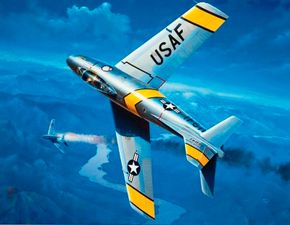
The North American F-86 Sabre, like the Boeing XB-47, had been the beneficiary of German aerodynamic data on the advantages of the swept wing for high-speed jet aircraft. The result was a single-engine fighter of superb maneuverability, and one that also was an excellent gun platform.
The North American F-86 Sabre was first flown on October 1, 1947, by George "Wheaties" Welch. There are those who say that the plane exceeded the sound barrier prior to October 14, 1947, the day on which Chuck Yeager did so in the Bell XS-1. There is no data to confirm this, but the fact is that the Sabre could go supersonic in a dive.
During these early years of the Cold War, the leaders of the United States Air Force had to plan on what the Soviet Union could do, not necessarily what it thought it would do. And the Soviet Union could have launched a one-way atomic bomber mission against the United States. Consequently, when the Korean War broke out, the North American F-86 Sabres were retained in the United States. (The designation P, for pursuit, changed to F, for fighter, in 1948.)
The appearance of Soviet MiG-15s in Korea changed this decision, and soon the beautiful little Sabres were flying the length of the Korean peninsula to challenge the enemy in "MiG-Alley." Although the MiG had some performance advantages, the better-trained and far more aggressive USAF pilots soon established air superiority. This allowed other USAF and United Nations aircraft to hammer enemy supply lines and prevent the overwhelming numbers of Red Chinese soldiers from driving the U.N. forces into the sea.
The versatile North American F-86 Sabre remained the heart of the USAF fighter force for many years and was developed through a long series of variants, each with improved performance. The aircraft was much loved by its pilots, and is regarded by many as the last "pure" fighter plane.
Wingspan: 37 ft. 1 in.
Length: 37 ft. 6 in.
Height: 14 ft. 8 in.
Empty Weight: 10,495 lbs
Gross Weight: 16,357 lbs
Top Speed: 675 mph
Service Ceiling: 48,300 ft.
Range: 785 miles
Engine/Thrust: One General Electric J47 turbojet/5,200 lbs
Crew: 1
Armament: Six .50-in machine guns
Ordnance: Two 1,000-lb bombs
Read More