One of the biggest challenges facing all branches of the armed forces is that it can be hard to know what gear to take when deploying for a distant assignment. Military personnel may discover that their jobs would be easier if only they had a special kind of equipment that just doesn't exist. Fortunately for the U.S. armed forces, there's an organization dedicated to fulfilling these kinds of wishes: the Prototype Integration Facility (PIF).
The PIF is a Government Owned, Government Operated (GOGO) facility that officially opened its doors in 2002 inside the Army post of Redstone Arsenal, Ala. It's under the jurisdiction of a special office in the U.S. Army called the Aviation and Missile Research Development and Engineering Center (AMRDEC). In turn, AMRDEC is subordinate to the Army's Research, Development and Engineering Command (RDECOM) division. These organizations are technological think tanks -- they develop new equipment and systems to give the U.S. military the advantage in the field.
The PIF grew out of two other organizations: the Prototype Engineering Directorate (also known as Skunk Works) and the Engineering Analysis Prototype Lab (EAP Lab). Skunk Works concentrated on mechanical prototypes and the EAP Lab created electrical prototypes. But these two groups were independent, autonomous, located in different facilities and rarely worked together. As projects became more complex, the Army recognized the need to create an organization that could incorporate both mechanical and electrical prototyping capabilities into one facility. The merger wasn't smooth -- the two groups had very different cultures. But they now work together as a cohesive group on projects.
The PIF fills a very specific niche. Its mission is to serve as a rapid response unit. That means when an Army project recognizes a need for a particular solution, the project manager can work with the PIF to create what the project needs. Sometimes, the PIF does this all in-house. In other cases, the PIF partners with other governmental agencies or even private businesses to meet the needs of its customers. In the end, the PIF's goal is to produce results as quickly as it can for the lowest possible cost.
It's important to note that the PIF focuses on prototypes rather than mass manufacturing. The facility builds and modifies equipment for very specific uses. Should that equipment prove particularly helpful, the Army could consider looking into a mass-produced version built by a different facility.
Let's take a closer look inside the facility.
Contents An engineer works on vehicles inside one of the two PIF bays.
Courtesy U.S. Army
An engineer works on vehicles inside one of the two PIF bays.
Courtesy U.S. ArmyOne of the first challenges the Army faced when forming the PIF was geographic in nature. The EAP Lab and the Prototype Engineering Directorate weren't located in the same building. Neither group had the facilities that the other group would need for efficient operation. The Army decided to construct a new building to house the joint operation.
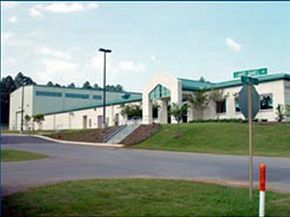
That new building is Building 5405 at the Army post at Redstone Arsenal, Ala. The Army secured $9.9 million in funding to build the new structure. The PIF is a 60,000-square-foot (5,574-square-meter) facility. It has two large construction bays inside it -- one is a 12,975-square-foot (1,205-square-meter) bay and the other measures 10,000 square feet (929 square meters). The facility also has a pair of heavy duty cranes and a helicopter landing pad [source: Chronister].
The large bays give engineers the room they need to work on equipment like tanks or helicopters. In addition to these features, the PIF also has multiple laboratories and fabrication facilities. For example, there's a complete circuit card design and layout lab inside the PIF. The PIF also has the capability to do the following:
In short, the PIF has all the equipment and resources a team would need to construct prototypes from design to fabrication.
But the equipment and facilities of the PIF are only part of the equation. The other part is the people -- the project teams that work on building prototypes for the army. As you might imagine, the PIF has a very structured chain of command.
At the top of this chain is the PIF Manager, who reports to the Deputy Director of the Engineering Directorate. The departments that report to the PIF Manager include project management teams, manufacturing, engineering, quality assurance, and business and operations management.
There are four kinds of project management teams: aviation systems, missile systems, special projects and research and development. Most of the work coming through the PIF relates to aviation or missile systems. These teams work together to manage projects. The PIF can shift resources from one group to the other as demands change over time.
The other departments are pretty self-explanatory. Engineering designs the prototypes, manufacturing builds them and quality assurance makes sure the prototypes meet all requirements. The business and operations management department oversees facility operations (including scheduling) and business relationships between the PIF, its customers and its project partners.
The PIF employs approximately 50 government workers and more than 100 contractor employees. The government employees focus on administration, engineering, program management and manufacturing support. The contractors work on engineering projects, electrical and mechanical fabrication and other support functions [source: Pope].
We'll take a closer look at the process for developing prototypes in the next section.
 A collection of grenade and landmine replicas designed as training materials.
Courtesy U.S. Army
A collection of grenade and landmine replicas designed as training materials.
Courtesy U.S. ArmyThe PIF tends to be a reactive rather than proactive facility. That means that the PIF responds to requests from other Army departments and projects (the PIF's customers). The PIF has a very structured prototype development process. Here are the stages:
This process has more in common with commercial business operations than traditional Army operations. Reportedly, some Army departments and projects have had trouble adjusting to the way the PIF does business [source: Chronister]. But it's hard to argue with results -- the PIF can often produce a prototype much more quickly and for less cost than older procedures.
Next, we'll look at some of the prototypes that have come out of the PIF.
 The PIF often works on projects like this mobile tactical command system.
Courtesy U.S. Army
The PIF often works on projects like this mobile tactical command system.
Courtesy U.S. ArmyOne PIF success story begins before the facility opened its doors. In 2001, the Army recognized the need for a weapon that could penetrate the thick concrete walls of enemy bunkers. AMRDEC took the lead on the project and began to investigate ways to modify TOW 2A missiles so that they could penetrate masonry. Once the PIF came online, it contributed to the project. In less than a year, the project team modified more than 100 missiles with the new bunker-busting technology [source: Pope].
Another missile modification project the PIF worked on was an improvement to the Hellfire II missile. The PIF worked with other departments to improve the lethality of the missile. In basic terms, that means they needed to make the missile more efficient and deadly. The team created a fragmentation sleeve that fits over a standard Hellfire II missile that wouldn't impede the missile's flight capabilities [source: Pope].
The example we used earlier of the mobile air traffic control tower has a basis in reality. The Army commissioned the PIF to create a Mobile Tower System (MOTS) to deploy in remote airfields. The PIF and the Army agreed to a contract that said the PIF had to design, build and deliver a prototype MOTS within a year. The tower had to include communications equipment that would allow soldiers in the tower unit to coordinate both air and ground maneuvers [source: PIF].
The PATRIOT Battalion Tactical Operations Center (BTOC) is another mobile operations unit the PIF designed. The BTOC is a mobile office inside a 5-ton van. It has computer workstations, printers, communications equipment, power supplies, encryption devices and a conference table [source: Federation of American Scientists]. The PIF built 16 BTOC vehicles over a two-year period [source: PIF].
 The mobile air traffic control unit allows Army personnel to deploy ATC towers to remote airstrips.
Courtesy U.S. Army
The mobile air traffic control unit allows Army personnel to deploy ATC towers to remote airstrips.
Courtesy U.S. ArmyRecently, the PIF began converting five Bell 206 helicopters from commercial aircraft into military choppers. The Army commissioned the helicopter conversion on behalf of the Iraqi Air Force. Once finished, the Army will deliver the helicopters to a U.S. training school in Iraq [source: Vaughn].
Not every PIF project involves modifying or building new weapons and vehicles. The fabrication facilities in the PIF allow engineers to create replicas of equipment for training or illustration purposes. For example, fabricators at the PIF have built replicas of land mines used by other nations as part of a training program for soldiers. The inert replicas are accurate in size, shape and weight and gave soldiers a safe way to study the explosive devices [source: PIF].
These are just a few of the projects the Prototype Integration Facility has been a part of in its brief history. As the nature of battle continues to evolve, operations like the PIF become more important to maintain a flexible and responsive military. The next time you hear about a nifty new military technology, there's a good chance it started out as a project at the PIF.
To learn more about the PIF and other military topics, march on over to the links on the next page.