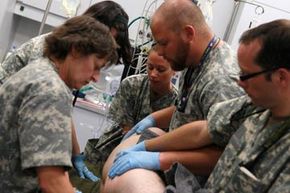
You want to join the Army, serve your country and see the world. You'd also love to become a doctor -- after all, the healing professions are just the thing for you. Hey, why not do both?
The Army needs doctors -- and offers generous financial assistance to attract them. The American Medical Association estimates the average cost of four years of medical school to be more than $250,000 [source: U,S, Army] and the Army offers aid to pay for the whole package.
The pay for an Army doctor may not be as high as that of a provider in private practice. Basic pay for an Army captain is $44,543 a year [source: U.S. Army], while the median salary of a general practice civilian physician is $119,122 [source: Pay Scale]. But completing a residency in a qualified field can bring a $75,000 bonus [source: U.S. Army]. Promotions, allowances, board certification and re-enlistment bring more money.
Plus, Army doctors often work shorter hours than their civilian colleagues. They enjoy regular vacations and excellent benefits. They have a guaranteed job with generous retirement benefits.
Some aspiring physicians are attracted to the life of an Army doctor. You won't need to build a practice or manage a business. No worries about malpractice insurance, no dealing with health insurance company bureaucracy. You'll have opportunities to travel and to enjoy the camaraderie of the service.
But the military lifestyle is not for everyone. The bureaucracy and hierarchy of rank can be a drawback for some. Most Army doctors are deployed overseas at some point (though not necessarily to a war zone), away from their families. And keep in mind that once you enlist, it's your superior officers who decide where you go and what you do. They will try to honor your preferences, but there are no guarantees.
About 65 percent of Army doctors are reserve officers, serving part-time when not called to active duty [source: Darves]. The rest opt for a full-time military career. Almost all medical specialties are represented. You'll also find opportunities to do research, to teach, or to work in medical administration.
Read on for some valuable tips for becoming an Army doctor.
Your first step will be to contact an Army recruiter. That person can give you a clear picture of your options.
If you decide to become an Army doctor, you will begin with same medical training as any physician. You'll attend either a civilian medical school or the special Uniformed Services University, a federal medical school that trains doctors for the Army, Navy, Air Force and Public Health Service. When you complete your education, which may include specialized training in combat medical skills, you'll enter the military with a captain's rank. Army doctors do not have to go through basic training. Instead, they attend a six-week Officer Basic Leadership Course, which teaches about military life and the role of a leader [source: U.S. Army].
Keep in mind that the Army requires the same high academic qualifications as any medical school. That means you need a solid grade point average and a good score on the Medical College Admissions Test (MCAT). You'll also need to have recommendations from professors [source: Darves].
The Army has additional qualifications that don't apply to civilian medical students. You need to be physically fit and must pass height and weight standards. You'll have to receive a security clearance [source: Darves].
The financial assistance opportunities are many. Here are some of the ways the Army can help with the cost of your medical education [sources: U.S. Army; USU; Directorate of Medical Education]:
Probably the best tip is: Don't become an Army doctor just for the money. Financial help with your education is great. But joining the military an important decision that will change the direction of your life. You need to be motivated by more than dollars.
The next section will give you more valuable information about becoming an Army doctor.