The United States military provides a long list of rules and policies for enlisted soldiers and recruits. This list is frequently updated and revised, and it includes stringent rules about appearance, as all members of the military are expected to maintain a conservative, neat look.
Military appearance regulations abound. For example, the Army enforces rules regarding:
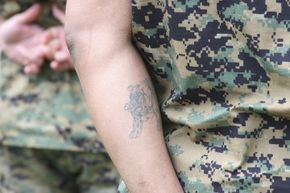
All four branches of the U.S. military have their own policies regarding tattoos. They prohibit any explicit, extremist, gang-related or racist tattoos [source: Rawlings]. However, in 2013, the Army revised its tattoo policy, making its regulations the strictest of all branches.
First, a little history. In 2006, during the Iraq War, the Army suffered a shortage of recruits. It relaxed its tattoo policy and accepted soldiers with hand and back-of-the-neck tattoos. But once the war ended and they no longer needed so many troops, it could afford to enforce the rules again.
The new 2013 policy banned tattoos on the neck, hands and face. Members were limited to four tattoos that had to be below the knee or elbow and no larger than the size of a hand. Sleeve tattoos were verboten, and band tattoos could measure only 2 inches wide. Previously enlisted soldiers with tattoos were grandfathered in. The most controversial part of the change, though, was that anyone violating this policy (including grandfathered soldiers) was no longer eligible for commissioning (a promotion) without a waiver. The subsequent outcry from enlisted personnel forced the Army to review and revise its policies. In fact, one National Guard member filed a lawsuit in federal court in an attempt to have the policy declared unconstitutional [source: Tan].
In 2014, the Army responded to the controversy and revised its tattoo policy. The revision removed the rule that required existing soldiers to get a waiver to apply for a commission. The rest of the regulations, however, remain in place as of January 2015.
HealthSkin & Your LifestyleHow Tattoos WorkHealthSkin & Your LifestyleHow Tattoo Removal WorksHealthSkin & Your LifestyleTattoos: Fast FactsHealthSkin & Your LifestyleAre there medical reasons to get a tattoo?HealthTreating Skin ProblemsCan sandpaper remove tattoos?HealthSkin & Your LifestyleAre tattoos bad for my skin?HealthPregnancy IssuesCan you get a tattoo if you're pregnant?HealthPostpartum CareCan you get a tattoo if you're breast-feeding?HealthSkin & Your LifestyleTattoos: Telling a Story of Self-esteem?HealthSkin & Your LifestyleDisappearing Tattoos for the Commitment PhobesHealthSkin & Your LifestyleCan you get a staph infection from a tattoo?HealthSkin & Your LifestyleTattoos May Be Good for Your HealthHealthSkin & Your LifestyleAt a Glance: Tattoos and Skin HealthHealthSkin & Your LifestyleI Got Tattooed With a Protostar ⦠For Science!HealthSkin & Your LifestyleBlackout Tattoos: Now That's Some Serious InkHealthDeath & DyingTelling Doctors Not to Resuscitate, by TattooHealthSkin & Your LifestylePediatricians Group Releases First-Ever Guidelines for Teens and TattoosHealthMusculoskeletal ConditionsBeing a Tattoo Artist Is a Pain in the Neck â LiterallyPeopleFadsHow Animated Tattoos WorkPeopleSubculturesHow Scleral Tattoos WorkPeopleBody ArtDNA Tattoos: Iâve Got You Into My SkinPeopleBody ArtHistory of TattooingPeopleBody ArtTop Tattoo Mistakes: LA InkPeopleBody ArtCelebrity Tattoo PicturesPeopleBody ArtDo tattoos have a smell?PeopleBody Art5 Tattoo Removal TipsPeopleBody Art10 Tattoo Virgin TipsPeopleBody ArtDo tongue tattoos affect your sense of taste?PeopleBody Art5 Most Embarrassing Celebrity TattoosPeopleBody ArtCan you get a glow-in-the-dark tattoo?PeopleBody Art10 Celebrity Tattoos We Just Don't GetLifestyleBody MakeupTattoo Concealer: Now You See It; Now You Don'tLifestyleHow Star Wars Works: Star Wars Celebrationâs Tattoo PavilionElectronicsOther GadgetsHow Electronic Tattoos WorkEntertainmentCircus ArtsHow did tattoos become a sideshow feature?ScienceSoldiersDoes the U.S. military have rules about tattoos?