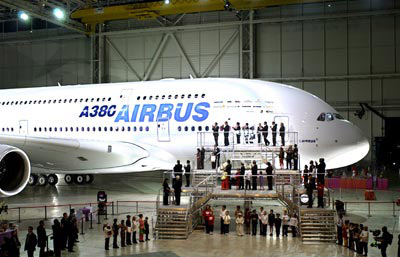
The Airbus A380 is generating a lot of excitement in the airline industry, with many people wondering if the world is ready for a plane this big.Plus, the program has been plagued by expensive delays. Although it has taken three test flights -- one in September 2006 and two in March 2007 -- the delays still lead some to wonder if it will ever be finished and ready for commercial production.
In this article, we'll find out just how big it is, how many people it can carry and whether it will revolutionize commercial aviation or turn out to be another "Spruce Goose."
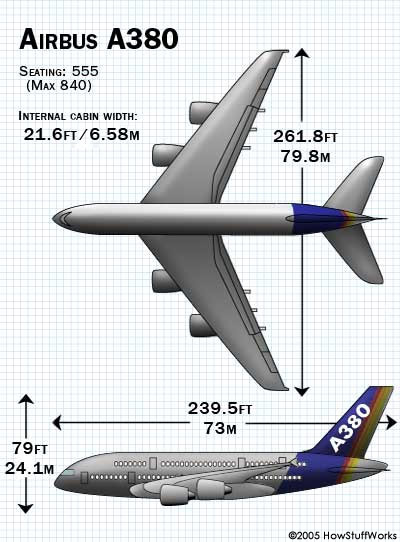
The Airbus A380 is truly a giant. It has a wingspan of 261.8 feet (79.8 meters), a length of 239.5 feet (73 meters) and a maximum take-off weight of more than 1.2 million pounds (540,000 kg).
While it is the largest passenger airliner ever made, it is not the biggest airplane in the world -- this honor belongs to the Ukrainian An-225 Cossack.
A plane this size can potentially carry hundreds more passengers than today's airliners. The A380's two passenger decks (with a cargo deck below) could be outfitted in a single-class configuration to take on up to 840 passengers. However, Airbus isn't focusing on that option, instead designing a three-class configuration for 555 passengers. That's still a marked increase over the 416 passengers that can fit into a Boeing 747-400, the current leader in passenger capacity.
In the next section, we'll talk about the A380's interior arrangement.
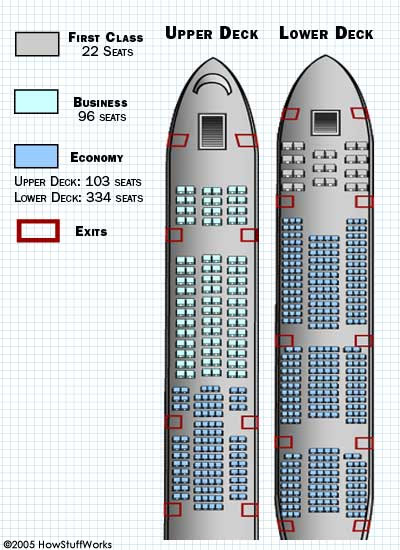
The reality is, economy class seats will be about 1 inch (2.54 cm) wider, while first-class seats may fold down into beds. Some have even suggested that the A380 could be outfitted as a "luxury jet," complete with a casino, shops, hot tubs and double beds.
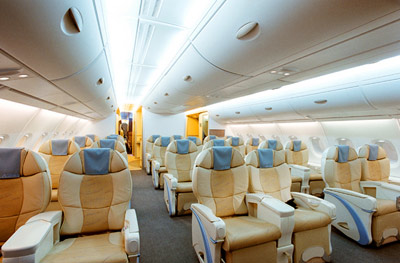
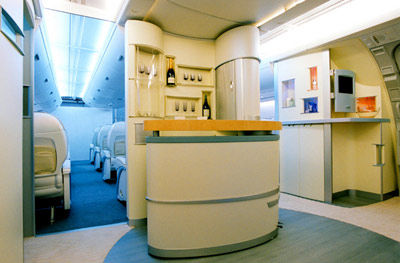
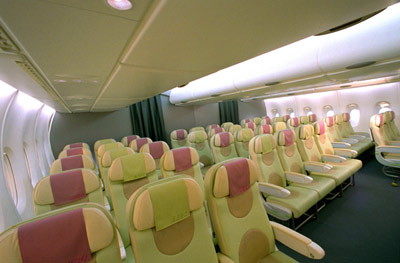
Most airlines are looking for efficiency rather than luxury, and the A380 provides that, as well. It has a range of 8,000 nautical miles and utilizes a host of new technologies and better engines to increase fuel efficiency.
In the next section, we'll discuss these advances in efficiency.
The Hughes HK-1 Flying Boat (known as the Spruce Goose for its all-wood construction -- see Evergreen Aviation Museum: Hughes Flying Boat) was built in 1947. With a wingspan of 320 feet (98 meters) and a length of 218.5 feet (66.6 meters), it was the largest plane in the world for many years. Only one was ever built, and it only flew once. "Spruce Goose" has become synonymous with ambitious, incredibly expensive projects that are ultimately doomed to failure.
The A380 comes in third overall when you compare planes by an average of their length and wingspan, but several other planes are in contention. These include the KM Caspian Sea Monster, a plane that uses ground effects to float just above the water (known as an Ekranoplan); the An-124 Condor; the U.S. military's C-5 Galaxy transport; and the Boeing 777-300ER.
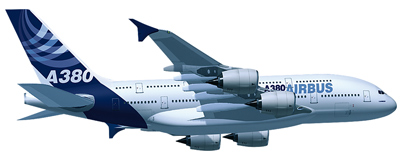
The operating cost of an A380 is not substantially greater than that of the Boeing 747 (the closest passenger jet in size and capacity). Every extra passenger on an A380 represents money made by the airline above and beyond what they could have made on a smaller plane. The increased range also helps add to an increased number of "seat-miles" per flight. The end result is a drop in per-passenger operating costs of 15 to 20 percent, according to Airbus.
Airbus has also introduced several updated technologies in efforts to make the A380 as fuel efficient and environmentally friendly as possible. High-efficiency engines are being developed by Rolls-Royce and a partnership between General Electric and Pratt & Whitney known as Engine Alliance.
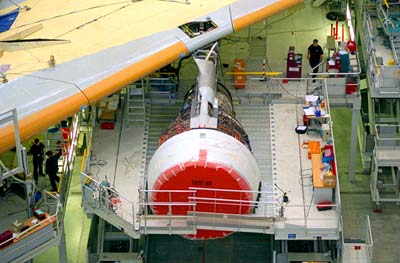
The use of lightweight materials has helped to keep the weight down, while extensive wind-tunnel testing has resulted in the optimum aerodynamic shape for the A380. Special dampeners keep the noise level coming from the engines down to about half that of other jumbo jets.
Carbon fiber, a strong, light but expensive material, is used on key parts of the A380. Roughly 25 percent of the plane's overall structure is made from carbon-fiber reinforced plastic (CFRP). To create the various shapes that comprise the A380, engineers use different processes. For large, flat pieces, a computer-controlled tape-laying machine processes resin-impregnated carbon-fiber tapes in a pressurized autoclave. For curved pieces, the CFRP fabric is shaped dry and then impregnated with resin. For some parts, large pieces of carbon-fiber were stitched together by computerized, industrial sewing machines.
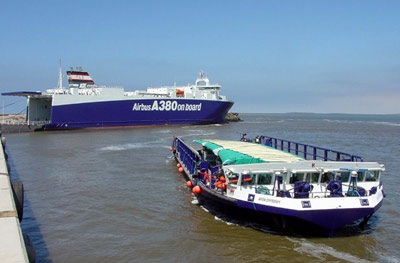
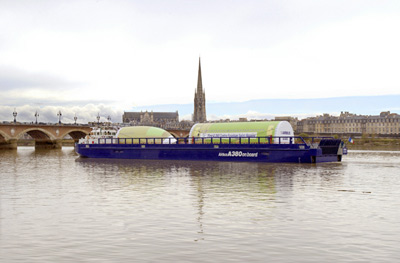
The tail assemblies are the only major part that can be transported by air (using the Airbus Beluga). A convoy of huge trucks carries the parts from Langon, France, to Toulouse. To accommodate such huge components, an entire infrastructure had to be created, including special river and seagoing vessels that allow parts to "roll on and roll off," customized port facilities and widened roads.
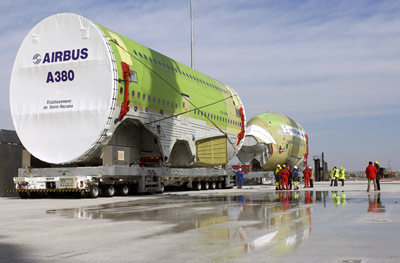
For more details on the manufacturing process, including photos, check out these links:
In March 2007, the A380 made its first flight to America. One plane, loaded with employees, landed in New York City to the cheers of onlookers. A second, empty plane landed the same day in Los Angeles. The flights demonstrated both the A380's readiness and the ability of airports to accommodate it.
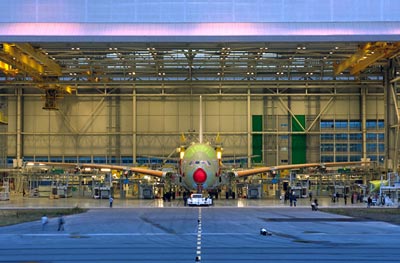
In 2000, the first orders for A380s came in, and Airbus began laying the infrastructure for manufacturing the huge planes. This included massive hangars and factories in France, Wales, Germany, Spain and England.
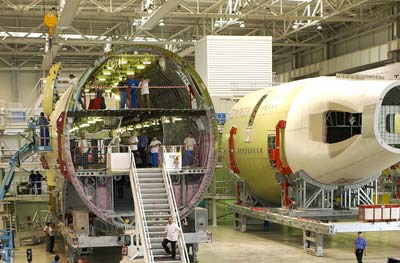
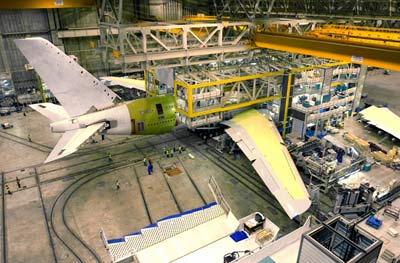
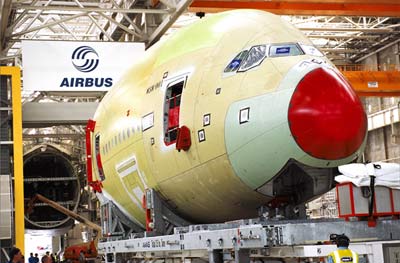
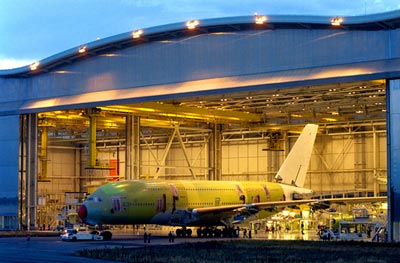
The A380 project had a staff of more than 6,000 people in 2002. While work was being done at the manufacturing end, sales were also picking up, with 14 airlines ordering 154 A380s as of early 2005.
The first complete A380 was unveiled on January 18, 2005. Its maiden flight was on April 27, 2005. The first flight with a load of passengers occurred on September 5, 2006 and the second on March 19, 2007. Although Airbus initially announced that it would still be able to deliver the first plane to Singapore Airlines by the end of 2006, the company announced further delays following the first test flight and now project to deliver by October 2007.
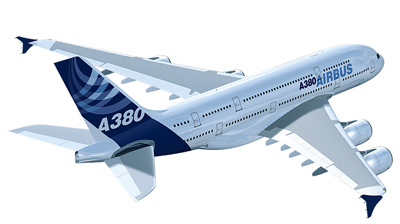
It's true that not every airport can handle the A380's enormous bulk, but the problem isn't with runways. Extensive testing showed that the weight of the plane would not cause too much extra stress on runways. In fact, the A380 uses more landing wheels than other large jets, so each wheel actually transmits less weight to the runway than some other aircraft. Most major runways are long enough for takeoff and landing procedures, though some are not quite wide enough (the A380's engines would hang over the edges slightly). Taxiways do need to be widened to accommodate such a large craft.
The bigger issue is terminal space. There just isn't enough space to park an A380 at most airport terminals. In order to smooth the process of getting such a large number of people on and off a plane, Airbus put in two entryways. Therefore, two gangways extending from the same terminal are needed. Only a few airports are equipped with this sort of setup. Even if the airport itself is built to take on large planes, the process of ticketing, checking luggage for and security screening so many people can be a logistical nightmare for airports. The A380 is aligned to serve international flights, which leaves little doubt that lines at customs and immigration will be very long for those passengers. If weather or scheduling problems forces two or more A380 to arrive somewhere at the same time, airports estimate it could take almost a day for every passenger to be processed and find their luggage. Similar problems were encountered when the 747 was first introduced.
Airbus says its focus is on linking major international hubs such as London and Hong Kong, not on reaching every major airport. The A380 will also find uses in shorter trips in Japan. The population density of the island nation means even short routes are regularly filled to capacity.
Some (notably Boeing, for obvious reasons, but environmental groups and airline industry experts, as well), have questioned whether the A380 will be as cost-effective as Airbus claims. Airbus' efficiency numbers depend on full loads of passengers. Even a few empty seats on a such a huge plane can really eat away at an airline's profit margins, as well as the plane's emissions-per-passenger numbers.
For more information on the Airbus 380 and related topics, check out the links on the next page.
Related HowStuffWorks Articles
More Great Links
Sources