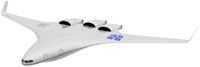
Back in 2002 and 2003, when air travel predicted to double in the coming decades, the government of the United Kingdom decided to initiate a study that would make life a lot less noisy for those living close to Heathrow Airport. Within that context, the Cambridge-MIT Institute began a research project designed to reduce aircraft noise for those on the ground. For the Silent Aircraft Initiative, an international team of graduate students, professors and commercial-airline engineers set out to design a plane that even people living under the departure and approach routes to major airports would hardly notice.
In November 2006, armed with a sleek proof-of-concept model called SAX-40 and all of the computer-generated statistics to prove the viability of near-silence to a room full of scientists, industry representatives and generally important people, the Silent Aircraft Initiative finds itself in a world with a slightly shifted perspective. Under stiff political pressure to curb climate change and fluctuating fuel prices, noise pollution has fallen a few spots on the priority list for aircraft research. Luckily, many of the design innovations that make the SAX-40 quieter than conventional aircraft also make it more fuel efficient, meaning fewer "greenhouse gas" emissions.
The SAX-40 is a major departure from the fairly uniform design of current commercial aircraft. In terms of size and capacity, the SAX-40 has been compared to the Boeing 757/767 class of aircraft.
 SAX-40 design
©2006 Cambridge-MIT Institute
SAX-40 design
©2006 Cambridge-MIT Institute
Some of the major design innovations implemented in the SAX-40 include:
These are only a handful of the noise-reduction and fuel-efficiency changes that make the SAX-40 a very interesting proof of concept. The body has lift-to-drag ratio of 25:1 compared to about 18 for a Boeing 767 , and it's up to 35 percent more fuel-efficient than a current commercial aircraft [Source: NASA]. Researchers predict that no one beyond the boundaries of a given airport would be able to hear the SAX-40 taking off or landing.
Even with all of these positives, the SAX-40 will probably never see the manufacturing line. The body design makes mass manufacturing difficult and expensive. In today's planes, the fuselage is practically cylindrical and changes very little from front to back. This makes it easy to produce multiple, identical pieces and then just pop them together. It also makes it easy to adjust the simple cylinder size to other aircraft models. With the SAX-40, the body shape changes over the entire length of the fuselage, and is not designed in segments. Aircraft companies are unlikely to take on the mass production and scaling of such a unique body shape. Still, while the SAX-40 may never see production, Professor Ann Dowling of Cambridge University predicts a 2030 date for SAX-40 design concepts to be integrated into more traditional commercial-aircraft designs.
For more information on the Silent Aircraft Initiative and related topics, check out the following links:
Sources