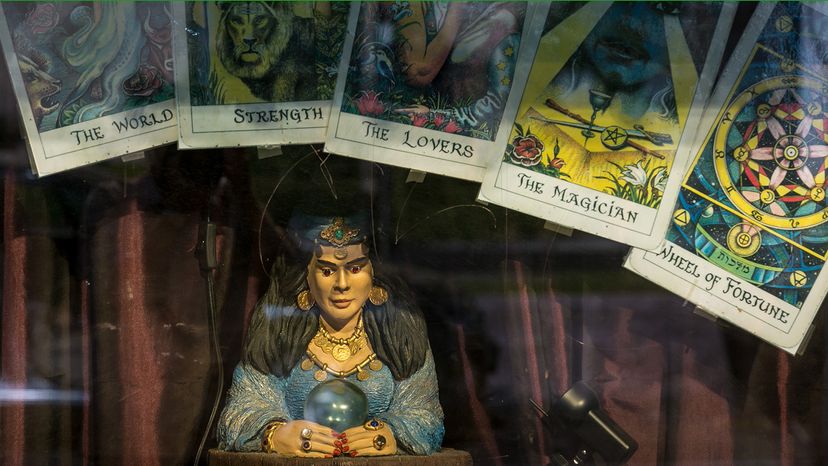
For many of us, a "Tarot card reading" means a woman in flowing robes, leaning over a small table in a candlelit room, foretelling impending doom.
But that's not really what Tarot cards are about. In fact, they're not even really meant to tell your fortune or future. As the occult organization The Hermetic Order of the Golden Dawn says, "The most powerful sources of information come from within; the Tarot aids in coming in contact with one's Higher Self."
But what does that mean? In this article, we'll look at the various ideas about where Tarot cards come from, what they mean and how a deck of cards can possibly tell you anything about yourself. You'll learn why it matters where the cards fall and why you don't have to be a psychic to do a Tarot reading.
Speaking of readings, the first thing to know is that there actually are two different types of Tarot readings: question readings and open readings. In question readings, you are addressing a specific question. Tarot is not intended to answer specific yes or no questions. Most say it also shouldn't be used to make decisions, but instead should be used as a guide to help you make the decision yourself. For this reason, the way a question is stated is very important. Tarot reader and teacher Joan Bunning gives this advice:
Open readings address the larger aspects of your life rather than a specific problem area or question. They're usually done when you're entering a new phase of life, such as getting married, graduating from college or starting a family. You can somewhat direct the reading if you have a general area you want to cover, such as your career or health, but that's as specific as the direction gets.
Contents The tarot deck most commonly used in the U.S. is the Rider-Waite tarot deck.
Photo courtesy Consumer Products
The tarot deck most commonly used in the U.S. is the Rider-Waite tarot deck.
Photo courtesy Consumer Products
There are many varieties of Tarot decks, and there is no standard number of cards across all decks. While the types of cards, the suits and their meanings are the same, the illustrations vary greatly. Decks are based on various themes such as nature, animals, fantasy, dragons, etc. The most common deck in the United States is the Rider-Waite deck, which was created in 1909 by A.E. Waite, a prominent member of the aforementioned occult group The Hermetic Order of the Golden Dawn, and published by Rider & Company. The artist was Pamela Colman Smith. This 78-card deck was the only readily available deck in the United States for many years, which is why some consider it the "definitive" tarot deck in the U.S.
The Tarot deck is made up of the minor arcana and the major arcana. Like regular playing cards, the minor arcana of the Tarot deck includes four suits. Rather than spades, hearts, diamonds and clubs, however, the suits are wands, swords, cups, and circles or pentacles
 Cards of the minor arcana: aces of wands, swords, cups, and circles and pentacles
Photo courtesy Angel Paths
Cards of the minor arcana: aces of wands, swords, cups, and circles and pentacles
Photo courtesy Angel PathsEach suit has meaning regarding a specific approach to life. The cards within these suits are numbered one through 10 and also include the court cards — the king, queen, knight and page. The minor arcana cards represent the more minor, practical daily ups and downs in life.
The major arcana are not associated with the suits. They include the picture cards that represent principles, concepts and ideals. They are numbered one through 21, with the 22nd card (the "Fool") marked as zero. The major arcana cards represent strong, long-term energy or big events in some area of life.
 Cards of the major arcana: Temperance, Death, the Fool and the Hanged Man
Photo courtesy Angel Paths
Cards of the major arcana: Temperance, Death, the Fool and the Hanged Man
Photo courtesy Angel PathsSeeing a major arcana card about a particular subject in one reading and then getting a minor arcana card about the same subject in the next reading would mean that this subject is becoming less important in your life. To check out various explanations of specific card meanings, see:
 The Celtic Cross Tarot spread. Photo courtesy Angel Paths
Before a reading occurs, the person receiving the reading shuffles the cards. Some say this transfers that person's energy to the deck. The person receiving the reading also should be concentrating on the question or area for which they want guidance while he or she shuffles the deck. In some more traditional circles, a more elaborate sorting and separation of the cards is performed.
Once the cards are shuffled and the deck has been cut, the reader lays out the cards in a pattern called the spread. Each position in the spread has a meaning, and there are many different types of spreads, ranging from those that incorporate a single card to spreads that include all 78 cards of the deck. Which spread is used is up to the reader and the specific type of question or reading. Some spreads focus more on a specific type of information. For example, one spread might concentrate more on emotional matters, while another might bring in more information about the influences of others. One of the most common spreads is the Celtic Cross. However, there are many more spreads for Tarot card reading, and readers can even make up their own.
Below, using the Celtic Cross spread as an example, you can see that there is an order in which the cards are laid down for the spread and that each card position within the spread has a meaning. There are many different meanings that each position can have — it depends on who you ask. This set of meanings comes from the Angel Paths Tarot and Healing website. The card meanings are combined with the position meanings. In addition, combinations of cards or card pairings also affect meanings.
 Tarot spreads vary, but one of the most common is the Celtic Cross. Learn how tarot spreads differ and the meaning of each position in a tarot spread.
Photo courtesy Angel Paths
Tarot spreads vary, but one of the most common is the Celtic Cross. Learn how tarot spreads differ and the meaning of each position in a tarot spread.
Photo courtesy Angel Paths The illustration demonstrates an approach for reading the Celtic Cross spread according to Tarot reader and teacher Joan Bunning. © 2018 HowStuffWorks
Once the cards are laid out, their meanings are interpreted based on their positions and their neighboring cards. Let's look at the Celtic Cross spread and begin.
Bunning suggests to then ask yourself how you feel about the projected outcome. What does it say to you?
Because Tarot cards each have one picture that faces in one direction, it is possible that cards will be facing the opposite direction when dealt. According to most sources, this doesn't change the meaning of the card, but simply weakens the impact of the meaning.
For more meanings, see Joan Bunning: Individual Tarot Cards.
What Do Tarot Cards Mean?Tarot cards have different meanings depending on where they fall in the spread. Here are a few of the face cards and their various meanings:
 A guest has her cards read at a Sundance party in 2007. Tarot readers who are interested in becoming certified can, but it's a voluntary exercise. Thos Robinson/Getty Images For LuxeLife
To learn the art of Tarot card reading, you can read books, take courses and even become certified. Courses are taught online and in classes through Tarot organizations and through independent Tarot teachers. Various organizations have offered certifications over the years, including The Tarot Guild. As Tarot isn't regulated, any certification readers elect to do is entirely voluntary. Typically to achieve these certifications, you must have varying levels of experience as well as pass standardized tests. Some of the certification levels may be as follows:
Other countries also have their own Tarot-certifying organizations.
Not sure that you want to go the certification route? You can always teach yourself Tarot:
 An assortment of Tarot cards Steve Allen/Stockbyte/Getty Images
How can randomly drawn cards have any relevance to someone's life and what's happening in it? What most readers say the Tarot can enlighten you about are the choices you have. The cards don't tell you what you should do or what specifically is going to happen in your future, but rather the possibilities depending on the path you take. Let's look at some of the theories behind how Tarot cards could possibly work.
Carl Jung believed that in addition to the repeatable cause-and-effect relationships on which the scientific world is so strongly based, there is also another connecting principle that does not share that cause-and-effect relationship. He called this principle synchronicity. According to Jung, synchronicity explains the guiding forces in the universe. Things we might see as coincidence are actually signs that can help us make decisions and guide our lives — if we recognize them.
Jung believed that quantum mechanics could be a possible explanation for the phenomenon of synchronicity. (Quantum mechanics explains the relationships of particles and their random interconnectivity, with behaviors being probabilities rather than certainties.) There are those who believe that because the forces of quantum mechanics affect the reality of physical objects, Tarot cards might play the role of showing us paths and patterns and helping us understand the meaning in those guiding energies. Although, according to the principles of quantum mechanics, once you see the possible outcomes in the Tarot reading, you've changed the probabilities. While Jung did not study Tarot, he was interested in I Ching (another divination tool) and suggested that synchronicity could be an explanation for how I Ching might work for divination.
Some say it all boils down to your subconscious mind. Arguably, how we perceive things relies heavily on our subconscious, and there are those who believe that with Tarot, the subconscious projects its own interpretations on the Tarot cards. As a person receiving a Tarot reading, your interpretation of the cards is a result of the factors in your life that shape who you are and what you are about. The questions you have about your life (usually the reason for consulting the Tarot in the first place) are projected onto the pictures, so you divine answers from what you see. In this way, the Tarot is useful in helping us to tap into our subconscious to find answers that we might never consciously think of. The Rorschach inkblot test uses a similar principle to delve into the subconscious. Whether you believe that Tarot cards hold any power or ability to shed light on your life, your problems or your future might depend on how easily you can open you mind to the idea of it. Many Tarot card readers have differing ideas about how or why the Tarot works. In fact, some say we only need the Tarot to help us until we learn to get in touch with our "inner guide" on our own.
 The death card in a Tarot deck can have multiple meanings, not necessarily grim either.
Steve Allen/Stockbyte/Getty Images
The death card in a Tarot deck can have multiple meanings, not necessarily grim either.
Steve Allen/Stockbyte/Getty Images
According to Tarot historian Tom Tadfor Little, traditional playing cards were first seen in Europe in 1375, having been brought over from the Islamic societies where they had been used for centuries before that. These cards were not, however, Tarot cards. At this point, he says, there is no evidence to show that Tarot cards had yet been created, which goes against many claims that ordinary playing cards evolved from the original Tarot deck.
It wasn't until 1440 that the cards that were most likely the origin of Tarot cards were first mentioned. In a letter from the Duke of Milan, there was a request for several decks of "triumph" cards to be used at a special event. The letter differentiated triumph cards from regular "playing" cards. It does appear, however, that the first Tarot decks were created as a game. There were four suits with cards numbered one through 10 and also court cards that included a queen, king, knight and page. The deck also included 22 symbolic picture cards that did not belong to any suit. The decks were used to play a game called triumph that was similar to bridge. In triumph, 21 of the 22 special picture cards were permanent trump cards. The game spread quickly to all parts of Europe. People began referring to as tarocchi, which is an Italian version of the French word tarot, around 1530.
In 1781, in France and England, followers of the occult discovered Tarot cards. They saw the symbolic pictures of the cards as having more meaning than the simple trump cards they were used for at the time. They used the cards as a divination tool, and occult writers wrote about "the Tarot." After this, the Tarot became a part of occult philosophy.
There are also those who believe that Tarot cards originated in Egypt. In some circles, they are thought to be the sole surviving "book" from the great fire that burned the libraries of ancient Egypt. In this theory, the cards are considered to be the hieroglyphical keys to life.
For more information on Tarot cards, Tarot card reading and related topics, check out the links that follow.
Originally Published: May 17, 2005