Snakes are unique creatures in that their bodies allow them to get into the cracks and crevices of the world that most other creatures cannot. Lacking rigid skeletons and extremities, snakes can contort their bodies in order to get into tiny holes, wrap around tree branches and slither over otherwise unmanageable rocks. These serpentine qualities are the inspiration for a new type of robotic, interplanetary probe, called a snakebot, being developed by engineers at NASA's Ames Research Center.
Since 1964, NASA has sent 10 robotic explorers to fly by, orbit or rove around Mars, but snakebots will give scientists an unprecedented look at the Martian landscape. Snakebots, which could be ready by 2005, will be able to dig into the loose soil of Mars and burrow down to depths that other robotic probes can't get to. They can slither into the cracks of the planet's surface. "A snakebot could navigate over rough, steep terrain where a wheeled robotic rover would likely get stuck or topple," lead snakebot engineer Gary Haith says.
Snakebots are expected to be more durable and cheaper than any probe that has ever been sent to investigate a planet. In this edition of How Stuff WILL Work, you'll find out how snakebots will explore other worlds, perform construction tasks and maybe even be sold as radio-controlled toys.
 Photo courtesy NASA
Snakebots are unlike any robotic probe ever to be used for space missions. In order for a robot to mimic the movements of a biological snake, some special design features have to be used. NASA's snakebots are a model of the polybot developed by Mark Yim of Xerox Palo Alto Research Center. Polybots are robots that are able to change their shape in order to perform a variety of tasks. Snakebots will slither and dig underneath the soil for geological surveying, or coil up to carry tools for construction in space.
The main body of a snakebot consists of about 30, identical, hinge-like modules that are linked together in a chain. These modules are connected by a central spine and work together to perform various functions. The snakebot frame will be constructed out of a polycarbonate material and covered by an artificial skin to protect it from the Martian elements. Here's a closer look at a snakebot's architecture and individual modules:
 An up-close look at the snakebot modules
Photo courtesy NASA
An up-close look at the snakebot modules
Photo courtesy NASA
Snakebots will be able to limit the weight of the spacecraft ferrying them to space. The snake-like design allows them to perform many tasks without a lot of extra equipment. "One of the many advantages of the snake-based design is that the robot is field-repairable," NASA engineer Gary Haith says. "We can include a bunch of identical spare modules with the snake on a space mission, and then we can fix the snakebot much easier than a regular robot that needs specific parts."
Unlike past robotic probes, snakebot will be very cheap. In contrast to the $135-million Mars Odyssey that was launched on April 7, 2001, snakebots will probably cost only a few hundred dollars each. In fact, the cost of the snakebot is so low that one researcher says there is a possibility of developing a toy version.
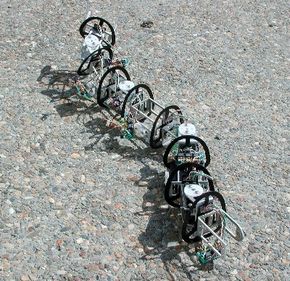
 Snakebots will be able to move easily over extraterrestrial terrain.
Photo courtesy NASA/Dominic Hart
Snakebots will be able to move easily over extraterrestrial terrain.
Photo courtesy NASA/Dominic Hart
Different types of snakes have different ways of moving through their environments, including side-winding, slithering and inch-worming. Snakebots will be able to perform all of those movements. They will also be able to coil and flip over in order to climb up and over obstacles. So far, the test versions of the snakebot have been remote controlled. Eventually, scientists will have to find ways to give these robots a form of intelligence so that they can operate far from Earth.
"Our first robot does what we tell it to do, no matter what the results are. If it comes to an obstacle, the robot will continue to try to go over it, even if the task is impossible," Haith says. "We made the first, simple robot because we wanted a working snakebot in a day or two, a robot that would help us to think about how a snakebot could and should move."
Work on a more advanced snakebot model, one that would be capable of independent behavior, has already started. The key component of this intelligent snakebot is a sensor-based control. Sensors embedded into the snakebot's body would enable it to make autonomous decisions about its movements. Part of that development will include writing software that will allow the snakebot to learn from its own experience. Such lessons may include how to crawl from soft to hard surfaces, how to go over rough terrain and how to climb scaffolds and get into cracks. "These abilities would help the robot look for fossils or water on another planet," Haith says.
Another improvement that researchers hope to make is to give the snakebot muscles. These artificial muscles would be made out of plastic or rubber material that would bend when electricity is applied. This would lower the snake's weight and make it tough "like an automobile tire," Haith says. One day, an army of these little snakebots could land on Mars and crawl off a lander spacecraft to perform deep searches of the planet. They might even begin to build a base for a future human colony.