In his poem "The Dry Salvages," T.S. Eliot described the river as "a strong brown god," a powerful force that, while often patient and nurturing, frequently proves itself untamable and merciless. The greatest cities in human history have risen up on the banks of rivers and by the seaside, but in doing so, their builders chose to live in close confines with an unruly force. Rivers have surged to wash away whole communities or changed course to abandon prosperous kingdoms to the dust. Even today, ocean storms threaten to decimate centuries' worth of human endeavor.
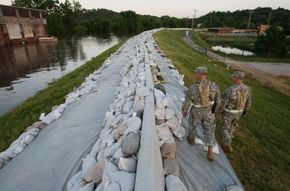
Humans have attempted to conquer the problems of changing water levels for thousands of years. One of the oldest weapons they've wielded against the rivers and oceans is the levee, also known as a dike. A levee is simply a man-made embankment built to keep a river from overflowing its banks or to prevent ocean waves from washing into undesired areas.
In New Orleans, the levees attempt to perform dual duties: On one side of the city, levees protect against floods from the Mississippi River, and on the other side, they help to keep Lake Pontchartrain at bay.
In parts of the Netherlands, dikes stop ocean waters from reclaiming thousands of miles of land, much of which is either at or below sea level. The famous windmills of Holland pump water from behind the dikes and back out to sea to keep the land dry. There are even parts of the Netherlands, called polders, where the Dutch have created new dry land along the sea by diking and draining it.
A levee is typically little more than a mound of less permeable soil, like clay, wider at the base and narrower at the top. These mounds run in a long strip, sometimes for many miles, along a river, lake or ocean. Levees along the Mississippi River may range from 10 to 20 feet (3 to 7 meters) tall. In Holland, they can top 30 feet (10 meters). But there's no set height for levees. Their measurements vary according to the storms the area receives, even if those storms occur only once every hundred or thousand years.
Living by the water provides humans with a number of advantages: fertile farm land, transportation, trade and hydroelectric power. Levees allow humans to enjoy these assets without fear of flooding. But humans have a bad habit of forgetting just how powerful their "strong brown god" really is.
 A helicopter drops sand bags to plug a levee break in New Orleans following the landfall of Hurricane Katrina in 2005.
Jerry Grayson/Getty Images News/Getty Images
A helicopter drops sand bags to plug a levee break in New Orleans following the landfall of Hurricane Katrina in 2005.
Jerry Grayson/Getty Images News/Getty ImagesWhile strolling along the beach or enjoying a picnic by a riverbank, it's easy to forget how powerful Earth's waterways really are -- until floods and storms jar us to remember. In 1927, the Mississippi River swelled under heavy rains, charging through a line of levees and flooding an area the size of Ireland. In 1953, the North Sea broke through the Netherland's ancient system of dikes and killed thousands.
In 2005, New Orleans made international news when Hurricane Katrina breached its levees. Much of the city lies 10 feet (3 meters) below sea level. Over the course of the city's history, low-lying, boggy areas have been pumped dry to create new land. Much of this reclaimed land has sunk as it dried out. The entire city now depends on the levees, along with massive pumping stations, to keep the water out.
Hurricane Katrina flooded 80 percent of the city, killing approximately 1,600 people and displacing some 200,000 others [source: Dolfman et al., Gonzales]. How could this happen? An investigation by the National Science Foundation pointed to five major reasons:
As New Orleans continues to rebuild from the disaster, some of these concerns are finally being addressed. The Netherlands faced a similar situation following the country's 1953 flood. How do its successes match up to New Orleans' failures?
 The windmills of Holland pump water from behind the dikes and back out to sea to keep the land dry.
© iStockphoto.com/pidjoe
The windmills of Holland pump water from behind the dikes and back out to sea to keep the land dry.
© iStockphoto.com/pidjoe
In the decades that followed the deadly flood of 1953, Dutch engineers set out to build a new kind of barrier against the sea. They steadily replaced the old dike system, which had been in place since the medieval ages, and created 350 miles (563 km) of what many consider the safest levee system in the world.
The Dutch set the standard for levee construction by re-evaluating their entire system in several key ways:
Much of the Dutch levee system relies on the understanding that levees require regular maintenance, constant monitoring and a long-term appreciation for how rivers, oceans and storms behave. When these are in place, communities can thrive safely alongside the beauty and convenience of coastal and riverside areas. It's when we fail to remember this that rivers and oceans become destroyers.
Explore the links below to learn more about storms, the ocean and other feats of human and natural engineering.
Sources