Without a doubt, the HowStuffWorks staff is anxious about the upcoming "Transformers" movie. We don't just wonder whether it will be good. We wonder whether we'll see robots with Transformers' capabilities during our lifetimes. While full-scale Transformers seem a little implausible - and impractical - it turns out that some existing robots have a lot in common with Transformers. In this article, we'll explore what these transforming robots look like, how they work and how they're similar to Transformers like Optimus Prime.
We'll begin with an analysis of Prime himself. He's enormous and impressive, but could he ever be real? To find out, we asked engineer Michael D. Belote what it would take to build a full-scale tractor-trailer that can convert into a bipedal robot. In other words, what would it take to make a life-sized version of Optimus Prime?
First, Prime has to be a self-reconfiguring robot. Some self-reconfiguring robots, or robots that can change their shapes to perform different tasks, exist today. However, they're very different from Optimus Prime. As Belote explains:
With self-reconfigurable robots, the engineer typically prefers to keep the individual, mobile modules small, simple, inexpensive, and interchangeable; in the case of Optimus Prime, however, we are dealing with a robot whose individual modules are as large as the cab of a semi truck. Even if building such modules were possible, the expense would be exorbitant, and the extraordinary complexity would make it virtually impossible to ever get all of the systems operating properly together.If engineers figured out how to make interchangeable modules on Optimus Prime's scale, it might still be impossible to provide the power to move them. In his vehicle form, Optimus Prime can run on ordinary diesel fuel. But walking is far less efficient than rolling on wheels. In order to walk, Prime would need far more power than a diesel engine could provide. Here's Belote's analysis of how to handle Prime's power requirements:
Traditional robots are built upon one of three power sources-electric, pneumatic, or hydraulic. Due to the extreme weights involved, hydraulic power is the most likely source for Prime, because hydraulic actuators provide very high power-to-weight ratios (large power output for small power inputs).So hydraulic power might allow Prime to walk, but the hydraulic system itself would create a different set of problems. "A tank or reservoir must be added to hold the hydraulic fluid," says Belote, "hydraulic pumps are necessary; a secondary power source must be used to power the pump; valves are necessary to meet the appropriate pressures and flow rates." In addition, a hydraulically-powered Prime would have to be lined with piping to carry the hydraulic fluid. These pipes, along with Prime's fuel lines and electrical wiring, would have to remain undamaged or even untouched during transformation.
After surviving the transformation to robot form, Prime would then have to walk as a biped. Belote describes what it would take for this to happen: Since traditional semis frequently exceed 30 tons in weight, the final weight of Prime could easily be in the 35 to 40 ton range. Compare this to the world's best "walking" robot, Honda's ASIMO robot, which has a total weight of 119 pounds and yet can only walk for about 40 minutes (electrically powered) and at a max speed of less than 2 mph. The weight ratio for ASIMO is 2.3 lbs per inch, compared to the weight ratio of Prime, which would likely exceed 75 to 80 lbs per inch -- a thirty-fold increase.
In addition, robots cannot easily mimic the motion of walking. "With a robot," Belote explains, "there is a direct command (lift leg 'x' amount, lean forward 'y' amount, extend leg downward 'z' amount, and so on). With humans, however, there is no 'feedback' mechanism - your brain does not constantly communicate to your legs on where to be placed. Instead, you simply lean forward and 'fall,' setting your leg to absorb the shock when your foot makes contact with the floor."
So it's not likely that we could see a working Optimus Prime or robot like him in our lifetimes. But robots that can change their shape or become any shape already exist. We'll look at some of them - and how they compare to Prime - in the next section.
Contents
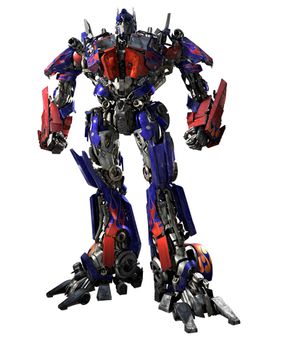
 Optimus Prime can be both a bipedal robot and a semi truck.
Image © 2007 Dreamworks Pictures
Optimus Prime can be both a bipedal robot and a semi truck.
Image © 2007 Dreamworks PicturesThe coolest thing about Transformers, of course, is that they can take two completely different shapes. Most can be bipedal robots or working vehicles. Some can instead transform into weapons or electronic devices. A Transformer's two forms have vastly different strengths and capabilities.
This is completely different from most real robots, which are usually only good at performing one task or a few related tasks. The Mars Exploration Rovers, for example, can do the following:
 An artist's rendering of a Mars Exploration Rover on the surface of Mars
Image courtesy NASA
An artist's rendering of a Mars Exploration Rover on the surface of Mars
Image courtesy NASAAn Exploration Rover wouldn't be very good at tasks that don't fit into these categories. It can't, for example, assemble a bridge, fit into very small spaces or build other robots. In other words, it would make a lousy search-and-rescue robot, and it wouldn't fit in at all in an automated factory.
 NASA's Snakebot is an example of a chain robot.
Image courtesy NASA
NASA's Snakebot is an example of a chain robot.
Image courtesy NASA A Telecube G2 module
Image courtesy Palo Alto Research Center Incorporated
A Telecube G2 module
Image courtesy Palo Alto Research Center IncorporatedThat's why engineers are developing reconfiguring robots. Like Transformers, these robots can change their shape to fit the task at hand. But instead of changing from one shape to one other shape, like a bipedal robot to a tractor-trailer, reconfiguring robots can take many shapes. They're much smaller than real Transformers would be; some reconfiguring robot modules are small enough to fit in a person's hand.
A module is essentially a small, relatively simple robot or piece of a robot. Modular robots are made of lots of these small, identical modules. A modular robot can consist of a few modules or many, depending on the robot's design and the task it needs to perform. Some modular robots currently exist only as computer simulations; others are still in the early stages of development. But they all operate on the same basic principle - lots of little robots can combine to create one big one.
Modules can't do much by themselves. A reconfiguring system also has to have:
Most modular, reconfiguring robots fit into one of three categories: chain, lattice and modular configuration. Chain robots are long chains that can connect to one another at specific points. Depending on the number of chains and where they connect, these robots can resemble snakes or spiders. They can also become rolling loops or bipedal, walking robots. A set of modular chains could navigate an obstacle course by crawling through a tunnel as a snake, crossing rocky terrain as a spider and riding a tricycle across a bridge as a biped.
Examples of chain robots are Palo Alto Research Center's (PARC) Polybot and Polypod and NASA's Snakebot. Most need a human or, in theory, another robot, to manually secure the connections with screws.
Simulated Robots
Computer simulations are a vital part of robotics research, particularly with reconfiguring robots. Scientists use computers to figure out how modules will move in relation to one another before teaching the modules how to do so. In some cases, computer simulations exist long before actual robots. The Massachusetts Institute of Technology (MIT) Rus Robotics Laboratory has numerous simulations of how these robots move around.
 Rus Robotics Laboratory's Molecule modules feature two cubes connected at a 90 degree angle. One surface on each cube houses the bond that connects it to the other half of the module. The other five surfaces can attach to other modules.
Image courtesy Keith Kotay/Rus Robotics Laboratory
Rus Robotics Laboratory's Molecule modules feature two cubes connected at a 90 degree angle. One surface on each cube houses the bond that connects it to the other half of the module. The other five surfaces can attach to other modules.
Image courtesy Keith Kotay/Rus Robotics LaboratoryThe basic idea of a lattice robot is that swarms of small, identical modules that can combine to form a larger robot. Several prototype lattice robots already exist, but some models exist only as computer simulations. Lattice robots move by crawling over one another, attaching to and detaching from connection points on neighboring robots. It's like the way the tiles move in a sliding tile puzzle. This method of movement is called substrate reconfiguration – the robots can move only along points within the lattice of robots. Lattice modules can either have self-contained power sources, or they can share power sources through their connections to other modules.
Lattice robots can move over difficult terrain by climbing over one another, following the shape of the terrain, or they can form a solid, stable surface to support other structures. Enough lattice robots can create just about any shape. Computer simulations show them changing from a pile of parts to a teacup and from a dog to a couch. The modules can combine to make flat surfaces, ladders, movable appendages and virtually any other imaginable shape. So a lattice robot is more like a Terminator T-1000 than a Transformer.
Robotics labs have created and theorized several lattice robot systems:
 Swarm-bots can maneuver independently, or they can combine to complete tasks they could not perform alone.
Image courtesy Professor Marco Dorigo
Swarm-bots can maneuver independently, or they can combine to complete tasks they could not perform alone.
Image courtesy Professor Marco DorigoLike lattice robots, mobile reconfiguration robots are small, identical modules that can combine to form bigger robots. However, they don't need their neighbors' help to get from place to place – they can move around on their own. Mobile configuration robots are a lot like cartoon depictions of schools of fish or flocks of birds that combine to create a tool or structure. They move independently until they need to come together to accomplish a specific task. Swarm-bots, a project by the Future and Emerging Technologies program in the European Union, are mobile reconfiguration robots.
Even though these robots look very different from one another, they have many similarities in how they move and operate. We'll look at these next.
A Really Real TransformerTransformers aren't necessarily practical or even possible on a large scale. But engineers at Himeji Soft Works have developed a small-scale robot that really turns from a car to a biped and back. You can see a video of this robot, including its transformation, at YouTube.
 Transformers are self-aware and can make decisions on their own, but their moving parts aren't autonomous.
Image © 2007 Dreamworks Pictures
Transformers are self-aware and can make decisions on their own, but their moving parts aren't autonomous.
Image © 2007 Dreamworks PicturesIn addition to their size and modular structure, self-reconfiguring robots are different from Transformers in one major way. Optimus Prime and other Transformers are self-aware and can make independent decisions, and they keep their brains in one location within their bodies. A Transformer's brain controls each of its moving parts, and the parts themselves have little if any autonomy.
In most modular robot configurations, though, each module has some decision-making power and gets to help figure out where it's going to move. Instead of one module being the boss of all the others, planning and movement capabilities are distributed across all of the modules.
This idea -- a swarm of little robots, each of which gets to decide where it's going to go -- might sound disastrous. But the modules are programmed with a set of geometry-based rules about how to move. They're also programmed with algorithms that govern their movement. These algorithms and rules allow the robots to figure out how to change from one shape into another and to move across terrain.
For very complex maneuvers, the robots instead plan out a series of sub-shapes rather than trying to make a major change in one step. For example, a lattice robot that needs to change from a random pile of modules to a bipedal robot might first form the legs. Then, it might use those legs as a scaffold to build the upper half of the robot.
 Currently, each modular robot system has its own rules to govern how it moves and reconfigures.
Image courtesy Palo Alto Research Center Incorporated
Currently, each modular robot system has its own rules to govern how it moves and reconfigures.
Image courtesy Palo Alto Research Center IncorporatedAt this time, many of these robots can make simple transitions from one shape to another on their own. More complex changes might require the help of a scientist, making the collection of robots semi-autonomous rather than autonomous. A few robots that are still in the early stages of development receive all of their instruction from a computer workstation and make no decisions on their own.
Currently, most re-configuring robots have their own system of rules and algorithms, and rule sets work only for the robots for which they were designed. In other words, the rules for Rus Robotics Laboratory's Crystal won't work with Molecule.
However, scientists are using computer simulations to research movement theories that could work regardless of what a robotic module looks like. These theories could establish ground rules for robot movement, including:
If successful, this research could make it easier for engineers to make new, working modular robots that follow the same rules of movement.
Even though these robots don't walk and talk like Transformers do, they can change into virtually any shape, given the right programming and instructions. To find out more about them and about Transformers, see the links on the next page.
Where do Transformers Keep their Brains?
While working on this article, the HowStuffWorks staff had a lively discussion about just where Transformers keep their brains. We all intuited the same answer - a Transformer's brain must be in its head (or in its cockpit in vehicle form). Many comic book and cartoon depictions seem to support this idea. However, it doesn't entirely explain how parts of Optimus Prime can operate separately, unless Prime uses radio or infrared signals to send and receive commands. It also doesn't entirely explain why Constructicons' personalities are different from their component Transformers'. You can read more about Transformers' brains and how they work at The Matrix, an unofficial Transformers magazine.
Sources