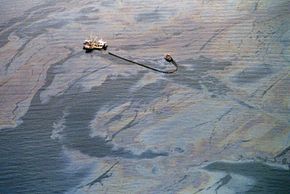
The Alaska pipeline is an amazing structure that carries oil from wells in the very far north of Alaska down to the ice-free port in Valdez, Alaska, where tankers pick up and transport the oil. The pipeline is 800 miles long and four feet in diameter. Sometimes it's above ground and sometimes below, and in the process, it crosses something like 800 rivers and streams.
More than 1 million barrels of crude oil move through the pipeline each day. At 42 gallons per barrel, that means that the pipeline supplies about 6 percent of the oil used in the United States.
You can get some sense of what would happen if the pipeline blew up by looking at a microcosmic event that occurred in October 2001. A hunter, apparently inebriated, shot the Alaska pipeline with a hunting rifle and punctured it. A bullet would not make a very big hole -- maybe the size of a dime. Because of the pressure, however, 120 gallons of oil per minute sprayed out of the hole. Over the course of 36 hours, the pipeline was shut down and the oil had to be drained from the punctured section so that it could be repaired. But in that 36 hours, over 300,000 gallons of oil sprayed onto the trees and ground around the puncture, creating a massive spill.
If someone were to blow up the pipeline, it would make the mess from a tiny bullet hole look like a pinprick. Assume that officials reacted quickly after the blast, shut down the pipeline, closed valves to block back-flowing oil, and had everything under control in 24 hours. Something like 40 million gallons of oil would be lying on the ground. That's enough oil to fill 40,000 swimming pools. Or enough to nearly fill an entire supertanker like the Exxon Valdez. Or enough to cover 100 acres of land in oil more than a foot deep.
 Saving wildlife, like this bird pulled from a 2007 spill in San Francisco Bay, is another factor in cleaning oil spills.
Courtesy Justin Sullivan/Getty Images
Saving wildlife, like this bird pulled from a 2007 spill in San Francisco Bay, is another factor in cleaning oil spills.
Courtesy Justin Sullivan/Getty ImagesIt would be even worse if the leak occurred near a river, because the oil would flow into the river and then downstream, destroying the river along the way.
Simply speaking, it would be a real mess. It took more than $2 billion to clean up the 11 million gallons that leaked from the Exxon Valdez. The advantage of a spill at sea is that much of the oil stays at sea and never makes it to land. In the case of the pipeline, you would possibly have almost four times the oil all in one place -- and it would all be on land. The oil would run off to the local streams and rivers, just like rainwater does, destroying all the wildlife in its path.
 Yahoo Buzz