We live in a world of endless cords and cables these days and, as anybody who's hooked up a computer can relate, before you know it, you can find yourself tangled up in an unruly jumble of electronic mess.
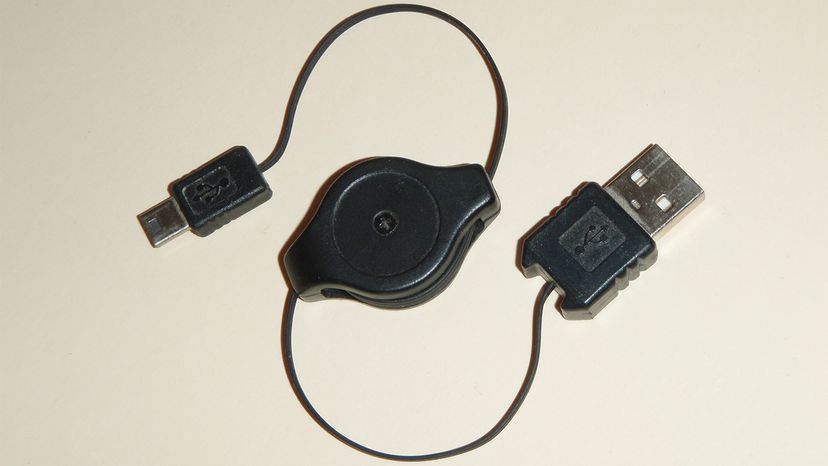
In an effort to prevent that problem, numerous modern gadgets — everything from steam irons and hair dryers to USB chargers for portable electronics — are equipped with retractable cords. They work on a pair of rotatable wheels inside a storage space that houses the entire length of the cord. When a user pulls the cord, extending it, the ratchets lock automatically, preventing the cord from rolling back up into its original storage position. A snap of the wrist or the press of a button will disengage the ratchets, unlocking them and allowing the cord to retract back into place.
You might think that retractable cords are a contemporary convenience, but actually, the term shows up in U.S. Patent Office documents going back to the early 1900s. For example, here's a patent awarded in 1939 for a vacuum cleaner handle, which is equipped with a grip that allows the user to control how much of the sweeper's electrical cord is wound back by the spring-operated drum inside it. This patent awarded in 1971 covers an electrical cord retracting mechanism.
Retractable cords have other uses besides electronics. The International Space Stationattaches an 85-foot-long steel retractable cable to any astronaut who ventures outside on a spacewalk.
Now That's InterestingRetractable cords aren't to be confused with retractile cords. The latter are covered with a specially-treated insulation or jacket that causes them to curl up, like an old-fashioned phone cord, according to the 2006 book "Cabling: The Complete Guide to Network Wiring," by David Barnett, David Groth, and Jim McBee.