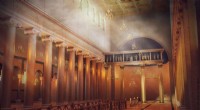
If a friend who was about to go off on a European adventure told you they were going to visit the Pantheon, would you immediately picture an ancient temple with white marble columns? What if that same friend told you they would also be stopping by the Parthenon? Would you imagine a similar scene in your head?
The point is many people get mixed up Pantheon vs. Parthenon discussions. And that's no surprise because the names are super similar. But the two are very different; they're not even in the same country.
The Parthenon, for instance, is in Athens, Greece, and the Pantheon is in Rome, Italy. The name of the former comes from the Greek word parthenos, which is an epithet of the Greek goddess Athena, meaning "virgin." The name for the latter also comes from Greek word, but pan in Pantheon means "all," and theos means "gods," meaning it's a tribute to all gods, not just one.
In short, these two famous buildings of the ancient world have very little in common.
We spoke with Christopher Ratté, a classical archaeologist and professor at the University of Michigan, and Dr. C. Brian Rose, the curator-in-charge of the Mediterranean Section at the Penn Museum and archaeologist who's been digging in the field for more than 40 years, to find out precisely what makes these two ancient temples so different.
ContentsThe Parthenon and the Pantheon are two of the most famous temples ever built in ancient Greece (Athens, to be specific) and ancient Rome. The Pantheon was constructed in the second century C.E., while the Parthenon we know today was built much earlier, around 447 B.C.E. However, neither, as they say, was built in a day.
The Pantheon is one of today's best-preserved buildings from ancient Rome. It was built sometime between 126 and 128 C.E. during the reign of Emperor Hadrian, who was emperor from 117 to 138 C.E.
"It was a reign largely marked by peace… there was plenty of money throughout the empire," Rose says. "Economically, it was a very prosperous time, and you see that reflected in the building program. [The Pantheon] is primarily made of concrete, but the inside is lined with marble imported from Egypt, Greece, Asia Minor and North Africa; these international materials bolster the Pantheon as a symbol of the extent of the Roman Empire."
On the other hand, the Parthenon took 15 years to build, Rose says. It was built between 447 and 432 B.C.E., during the aftermath of the Persian Wars, to highlight the victory of the Greeks over the Persians.
At the time, the Greeks were led by (or controlled by, depending on who you talk to) Athens, which was being controlled by a commander named Pericles. Athens had access to a treasury that could pay for additional arms conflict if the Persians returned. This treasury helped to fund the construction of the Parthenon.
The Greeks credited the goddess Athena with steering them toward victory, which is why, had you visited the site at the time, you would've found her statue in the temple's main room.
While both were built to honor gods, the Parthenon was created to honor Athena and the Pantheon was built to celebrate all the Roman gods.
"Both have many other cultural meanings," Ratté says, "the Parthenon as a victory monument and a symbol of Athenian power, and the Pantheon as a kind of architectural mirror of Roman imperial dominion."
The Parthenon also originally contained a massive statue of Athena inside the temple designed by Greek sculptor and architect Phidias. It was said to be more than 37 feet (11.5 meters) tall and constructed of gold and ivory. The statue was dedicated in 438 B.C.E. and remained for 1,000 years until it disappeared.

You could look at both structures and think that the architecture of the Parthenon influenced the building of the Pantheon. But that's far from the case.
First, the Parthenon was built high on a hill in Athens and features the architectural column styles of Doric and Ionic order, two of the three canonic orders of classical architecture. The structure is dominated by outer columns in Doric style that lean slightly inward to give the illusion of straight lines.
The Pantheon's dominating design is its massive domed ceiling and rotunda. It was the largest in the world at its construction in the second century. Today, the Pantheon sits in the heart of Rome on the same site as the original Roman Pantheon, built around 25 B.C.E. by Marcus Agrippa, son-in-law of the first Roman emperor, Augustus.
Unlike the Parthenon, which is original, the Pantheon has been rebuilt numerous times, mostly because of frequent fires in Rome.
"The basic form of the Pantheon has changed over the years… the Pantheon is a much more daring engineering marvel [than the Parthenon] because of the extraordinary span of the dome — the largest domical space that had ever been attempted in antiquity and not superseded until the Renaissance," says Rose.
While both the Pantheon and the Parthenon are open to tourism, the structures have different functions. "The Pantheon is intact and looks very much as it did when it was built, although some of its interior decoration has been altered," Ratte says. Today, the Pantheon is a Roman Catholic church, and visitors can view much of the original construction while learning more about it on a guided tour.
Although the Venetians blew up the Parthenon in 1687, Ratte said, "it is still one of the best-preserved of all Greek temples, and many of its fallen columns have been re-erected." Today, the Parthenon serves more as a museum of ancient Greek history.
Despite having many differences, the two structures also have many similarities. Both were built as temples and became churches in the early Middle Ages — Bernini put bell towers on the Pantheon, which have since been removed.
Both use columns extensively in their designs and have faced destruction, looting and rebuilding efforts through the centuries.
Now That's InterestingThere is a full-scale re-creation of the Parthenon in Centennial Park in Nashville, Tennessee, where you can see the structure as it was in ancient Athens. Inside is a 42-foot (12.8-meter) statue of Athena. The replica is a celebration of classical architecture built for Tennessee's 1897 Centennial Exposition.