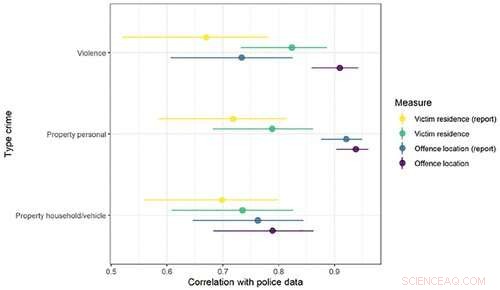
Figure 1. Correlation with the police data by topic and “method” in the data aggregated for 2015 to 2020. Variables were transformed prior by adding 1 and taking the log. Credit: DOI: 10.1177/00111287211064779
As part of the ESRC research grant Recounting Crime, Alexandru Cernat, David Buil-Gil, Ian Brunton-Smith, Jose Pina-Sánchez, and Marta Murrià-Sangenís have published a new article in the journal Crime & Delinquency.
In their work they assess if asking victims about the places where crimes happen leads to estimates of "crime in place" with better measurement properties. They analyzed data from the Barcelona Victimization Survey (2015–2020) aggregated in 73 neighborhoods using longitudinal quasi-simplex models and criterion validity to estimate the quality of four types of survey-based measures of crime.
The distribution of survey-based offense location estimates, as opposed to victim residence estimates, is highly similar to police-recorded crime statistics, and there is little trade off in terms of the reliability and validity of offense location and victim residence measures. Estimates of crimes reported to the police show a better validity, but their reliability is lower and they capture fewer crimes.