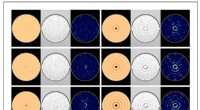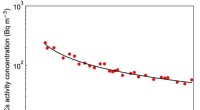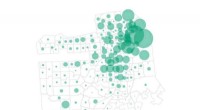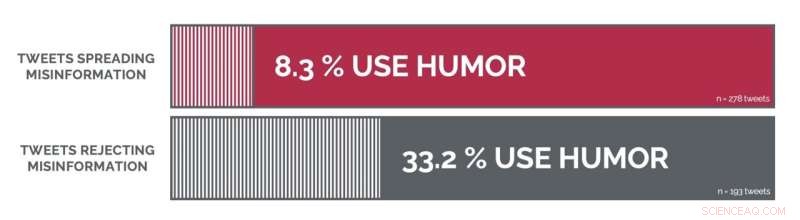
The studied tweets were very different with regard to the use of humor. 33 percent of all tweets rejecting misinformation used different forms of humor. This was only true of 8 percent of all tweets spreading misinformation. Credit: Copenhagen Center for Social Data Science
Democracy is largely based on the idea that we as citizens can discuss matters openly with citizens aiming to be truthful.
But what happens to the democratic debate when some people spread false stories and misinformation? This was the main research question of a new study conducted at the University of Copenhagen and Aarhus University, which has analyzed the spread and refutation of misinformation about facemasks on Twitter during the COVID-19 pandemic.
From a democratic debate perspective, the results are not encouraging, says Professor Rebecca Adler-Nissen, who is one of the five researchers behind the study:
"We tend to believe that people eager to correct misinformation will be very fact-oriented. But our study shows that this group of people typically choose to ridicule those spreading misinformation. Instead of bridging gaps or inviting people to change their minds by updating their knowledge, their response to misinformation takes the form of know-it-all remarks intended to patronize their opponent and praise themselves."
The majority does not focus on facts
The researchers, who are affiliated with the Center for Social Data Science (SODAS) at the University of Copenhagen and the Center for Humanities Computing, Aarhus University, Denmark, have analyzed 9,345 Danish-language tweets about facemasks and COVID-19 posted between February and November 2020.
Their analyses show that only around five percent (471 tweets) focus on misinformation. Of these, around three percent of all tweets and retweets about facemasks disseminate misinformation. That is, untenable arguments, which for example claim that facemasks are dangerous because they raise the user's CO2 levels or that they are superfluous because COVID-19 is pure fabrication.
Conversely, fewer people—around two percent of the 471 tweets—attempted to correct the misinformation. But contrary to the researchers' expectations, this only happened in 28 percent of the cases involving counterarguments.
62 percent of the cases focussed on deriding, ridiculing or stigmatizing the sender of the misinformation, often using humor: 33 percent of all tweets rejecting misinformation used satire, irony and humor. This was only true of eight percent of the tweets spreading misinformation (see figure). The remaining 10 percent of the tweets rejecting misinformation responded to misleading newspaper articles and were written in a more neutral tone.
We speak to 'our own' people
Consequently, the researchers conclude that a lot of the people who either spread or reject misinformation are really trying to do the same thing: namely defend their own social position among like-minded people.
In this specific case, they are more interested in their own status than in the advantages and disadvantages of facemasks. Thus, the debate is derailed, Ph.D. Student Nicklas Johansen explains.
"The social media tone has always been fierce, and of course, people may wish to openly correct false or absurd assertions—also on Twitter. But the result can be great polarization if people begin to stigmatize others as crazy. And a society that cannot bridge gaps has no cohesion," he says.
At the same time, the researchers stress that the study calls into question our ability as citizens to discuss and correct misinformation in social media when those who should know better often choose to ridicule rather than to inform.
This insight may affect the way we handle and regulate hate speech and the spread of misinformation, Rebecca Adler-Nissen concludes:
"Twitter in the US has experimented with tasking volunteers with checking assertions. Our analysis suggests that this is a complex task. Because people do not go online simply to exchange information, but also to consolidate their own status and identity. When people commit to fighting misinformation, it is also a way to make themselves visible to like-minded people. And we need to be aware of that dynamic."
The research was published in the Harvard Kennedy School Misinformation Review.